
Tags
a whole universe of ideas, Annie Dillard, Anthony Grootelaar, inspiration, Mark Doty, metaphor, Nature, poetry, the creative process, writing, writing about what fascinates us, writing on writing
One of the things I love most is writing about writing, unraveling the creative process, how the mind at play works.
Mark Doty’s essay Souls on Ice, describing how he came to write a particular poem, is a fascinating example of that. He puts into words something I’ve long felt and toyed with—how certain images, feelings, experiences will strike me as singularly important. Somehow they seem deeply relevant to the world at large, as if I pulled hard enough and long enough at one of these loose strands I’d see how it’s all connected and, in the process, unravel one small corner of the mystery that underlies the universe.
Below are parts of the essay that spoke so eloquently to me, but I highly recommend reading the whole thing at the link above.
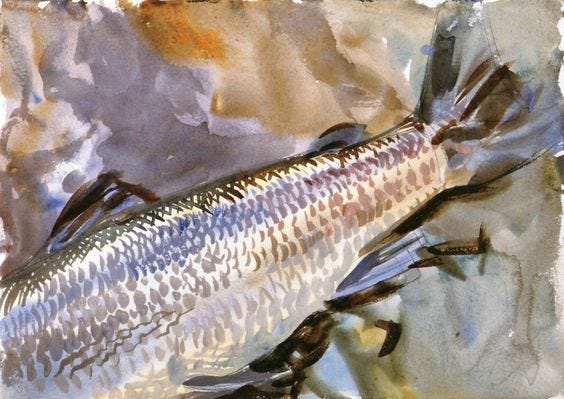
It begins with Doty “struck by the elegance of the mackerel in the fresh fish display” and how this sighting prompted his poem “A Display of Mackerel.”
“Our metaphors go on ahead of us, they know before we do. . . . . I can’t choose what’s going to serve as a compelling image for me. But I’ve learned to trust that part of my imagination that gropes forward, feeling its way toward what it needs; to watch for the signs of fascination, the sense of compelled attention (Look at me, something seems to say, closely) that indicates that there’s something I need to attend to. Sometimes it seems to me as if metaphor were the advance guard of the mind; something in us reaches out, into the landscape in front of us, looking for the right vessel, the right vehicle, for whatever will serve. . . .
I almost always begin with description, as a way of focusing on that compelling image, the poem’s “given.” I know that what I can see is just the proverbial tip of the iceberg; if I do my work of study and examination, and if I am lucky, the image which I’ve been intrigued by will become a metaphor, will yield depth and meaning, will lead me to insight. The goal here is inquiry, the attempt to get at what it is that’s so interesting about what’s struck me. Because it isn’t just beauty; the world is full of loely things and that in itself wouldn’t compel me to write. There’s something else, some gravity or charge to this image that makes me need to investigate it.
“Exploratory description, then; I’m a scientist trying to measure and record what’s seen.”
The poem follows. See how his plucking at one loose thread leads to the unraveling of a whole universe of ideas.
A Display of Mackerel
They lie in parallel rows,
on ice, head to tail,
each a foot of luminosity

barred with black bands,
which divide the scales’
radiant sections

like seams of lead
in a Tiffany window.
Iridescent, watery

prismatics: think abalone,
the wildly rainbowed
mirror of a soapbubble sphere,

think sun on gasoline.
Splendor, and splendor,
and not a one in any way

distinguished from the other
—nothing about them
of individuality. Instead

they’re all exact expressions
of the one soul,
each a perfect fulfilment

of heaven’s template,
mackerel essence. As if,
after a lifetime arriving

at this enameling, the jeweler’s
made uncountable examples,
each as intricate

in its oily fabulation
as the one before
Suppose we could iridesce,

like these, and lose ourselves
entirely in the universe
of shimmer—would you want

to be yourself only,
unduplicatable, doomed
to be lost? They’d prefer,

plainly, to be flashing participants,
multitudinous. Even now
they seem to be bolting

forward, heedless of stasis.
They don’t care they’re dead
and nearly frozen,

just as, presumably,
they didn’t care that they were living:
all, all for all,

the rainbowed school
and its acres of brilliant classrooms,
in which no verb is singular,

or every one is. How happy they seem,
even on ice, to be together, selfless,
which is the price of gleaming.
Annie Dillard says something similar:
A writer looking for subjects inquires not after what he loves best, but after what he alone loves at all. Strange seizures beset us. Frank Conroy loves his yo-yo tricks, Emily Dickenson her slant of light; Faulkner the muddy bottom of a little girl’s drawers visible when she’s up a pear tree.
Why do you never find anything written about that idiosyncratic thought you advert to, about your fascination with something no one else understands? Because it is up to you.
You were made and set here to give voice to this, your own astonishment.
My own astonishment, yes. To give voice to the things that seize me, that take me by the throat and shake me. Or is it me taking the thing by the throat and shaking it? Trying to shake loose its truth, the thing I want to know, the thing I know is there, but haven’t quite gotten it yet. The thing that must be seen, must be spoken. The thing I need to say.
When I look at the things I write about, that I’m drawn to write about, that seize me, here’s what I see, what I’m drawn to explore:
The gap between appearance and reality; between what’s real and what’s not, and how we can ever truly know for sure. If it’s possible at all.
The dark and the light, good and evil, beauty and brutality, the foolish and profound: how they play together, how they are all wound up in each other, how it’s almost impossible to tear them apart, as least in our ordinary, daily experiences. They lay side by side, or one on top of the other; they copulate over and over, and we, this life itself, is what they give birth to.
Mind and matter, nature and art, science and spirituality: They too seem rolled into one. It’s hard to separate the one from the other. They are shot through with each other. What fascinates me is how certain patterns emerge over and over. How they seem to tell us something about Life, about ourselves, about what this whole world stretching out beyond the cosmos is all about. If you pay attention to the patterns, to the fractal self-similarities, you taste something that smacks of truth. Of what we were created to discover.
What is it that fascinates you in your own writing or artwork? What do you return to over and over again?
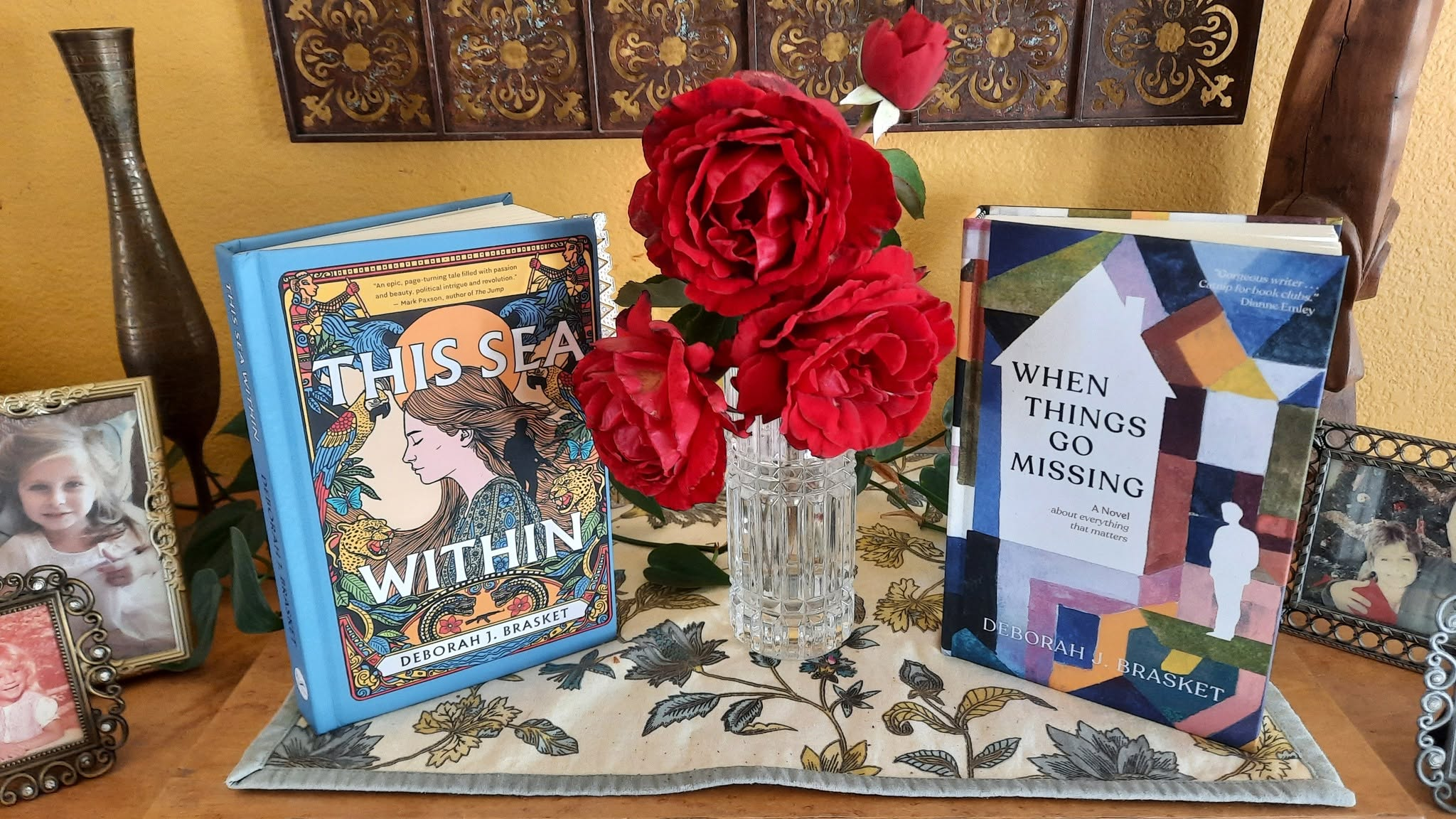
I hope you get a chance to explore some of the things that fascinated me enough to write these two novels.
When Things Go Missing is now available for free on Kindle Unlimited at this link. This Sea Within is also available Amazon, Barnes and Nobles, and Bookshop.
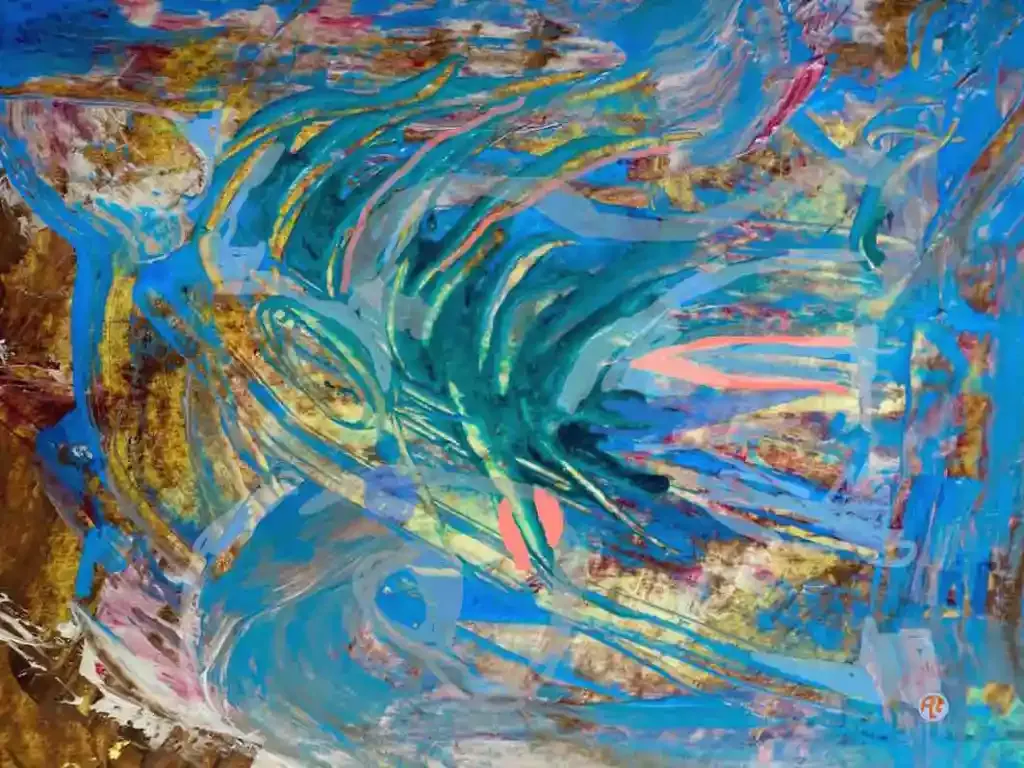
Note on featured artwork: More of Anthony Grootalaar’s art can be found on Instagram. He used to have a blog called MONKEYMIND, of which I was a huge fan. He gave me permission to use his artwork. He was also on Etsy, but I can’t find him there anymore.
Discover more from Deborah J. Brasket, Author
Subscribe to get the latest posts sent to your email.

Thanks for this fascinating dive into what captures our attention and drives our writing. The metaphor approach is the most interesting to me. Occasionally, I have felt drawn to an image or idea, or my mind has hatched something that calls to be noticed and written about. Lately, my writing has been much more mechanical.
LikeLiked by 1 person
Thanks for sharing this, Brad. With your photography and poetry, it seems nature is something that calls to you.
LikeLiked by 1 person
Yes, nature often calls me.
LikeLike
I think I find the creative process so interesting, because it never seems to stay still. I’m always learning something new. Appeals to the learner in me. Interesting piece Deb!
LikeLiked by 1 person
I’m glad you enjoyed it, Brian. The creative process is a fascinating subject!
LikeLiked by 1 person
It’s good to read all this about the creative process, Deborah.
LikeLiked by 1 person
I’m glad you liked it Tim. Thanks for letting me know.
LikeLiked by 1 person
My pleasure, Deborah. 😍
LikeLike
The creative process is endlessly fascinating!
LikeLiked by 1 person
You are so right, Liz!
LikeLiked by 1 person
Lots to think about there, Deborah. Thanks for sharing. 🙂
LikeLiked by 1 person
You are welcome, Laura! Thanks for stopping by.
LikeLiked by 1 person
this is so interesting, deborah. i think about my process as well, and i often gather inspiration by things i see or hear. i’m not always sure where they’ll lead me, but i’m okay with that, and in the end it’s nothing like i had imagined it would be. hope this makes sense. it also reminds me of when i want to decorate or change a room or even buy a home. i find something, an object, or color perhaps, something i’m drawn to, and i plan my room around it or keep for when i buy my house because i liked it’s style.
LikeLiked by 1 person
Yes! I’m not always sure where things are going when I write either and part of the fun is to SEE what comes next, as if pulling those threads brings a new idea to the surface. Also, I’m the same with decorating too, a color or combination, or an object will inspire me to plan everything around that. Thanks so much for sharing this, Beth!
LikeLiked by 1 person
Thanks for sharing, Deborah. I see you posted this poem 11 years ago as well. Thanks for the link to the essay. I read it, and what stood out for me was this sentence: A poem is always a made version of experience.
I love that because it’s our attempt at understanding, of putting our experience into words, a poem, which itself becomes its own entity, which, when read by others, may induce their own experience.
I had to smile to myself when I read your thoughts on what you’re drawn to explore: The gap between appearance and reality; between what’s real and what’s not, and how we can ever truly know for sure. If it’s possible at all.
The Romantic Poets wrestled with that philosophical notion as well: the lamp and the mirror, the light of reality and the reflections of it, creative inspiration and what gets created from it.
And, as you quoted Annie Dillard: You were made and set here to give voice to this, your own astonishment.
Here’s to being astonished and writing about it. Or writing, and being astonished from what comes out on the page.
LikeLiked by 1 person
Thanks so much, Ken. Yes, I’ve been drawing from the archives lately for posts, especially as I’m so busy writing my next book in the Sea Within series there’s little time for anything else. Plus it’s fun to go back and see what drew my interest in the past. I get so many new subscribers each month, i figure there are many who never read my blog 11 years ago! Thanks for your thoughts on Romantic poets–the mirror and the lamp, I’d forgotten about that!
LikeLiked by 1 person
Hi Deborah, I’m pleased I followed your link and read this post. It is fascinating and mirrors my own reflections on how and why I strive poetry. When I first wrote I followed the ideas that came to me as inspiration but writing for prompts has taught me how to actively generate writing ideas for a specific idea.
LikeLiked by 1 person
Thanks, Roberta! So happy to see you here. I haven’t tried writing prompts yet, but I can see how it would be a creative challenge and way to allow for more spontaneous writing. It’s always fun to see what the muse will pull up from the subconscious to feed our writing.
LikeLike
Yes, that is exactly right. A prompt stimulates a creative response. It’s a way of forcing creativity for me.
LikeLike
Wonderful read on this blessedly rainy day in SC. 🙂
LikeLike
I love the depth of where this goes and the unraveling of the creative process, Deborah. Thanks for sharing this💕
LikeLiked by 1 person
You are so welcome, Cindy. I love this kind of unraveling too.
LikeLiked by 1 person
It’s a gift! ❤️
LikeLiked by 1 person