
Tags
analyzing literature, analyzing writing, character-building, Deborah J. Brasket, deep-reading, novel writing, opening chapters in a novel, opening paragraphs, reading between the lines., The Writing Process, When Things Go Missing, writing
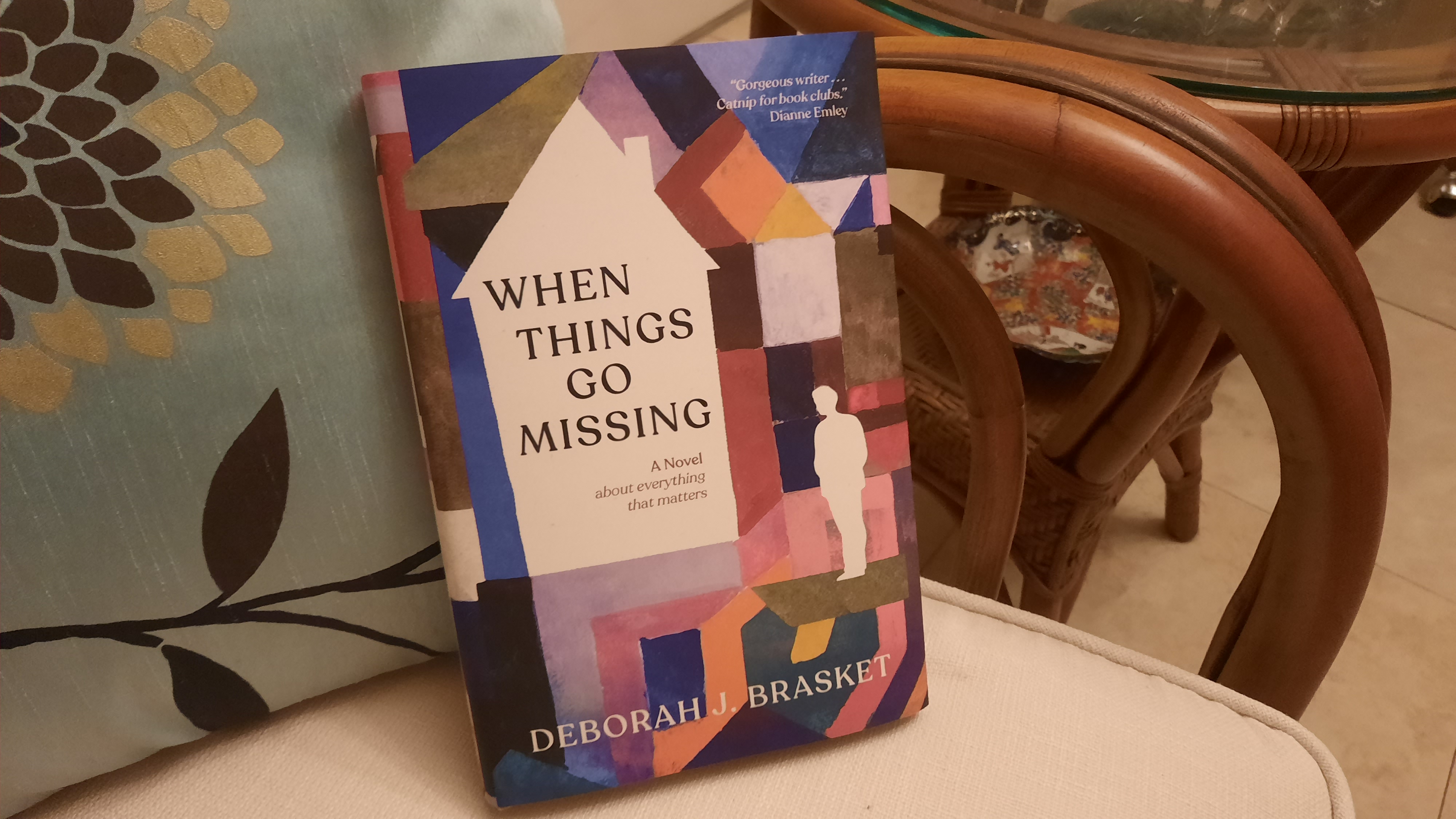
As an English major and teacher I loved analyzing literature, looking at the first sentences and paragraphs of books to see what they reveal, what they promise the reader. Now as a novelist, it’s interesting to investigate my own books, first lines and paragraphs, and see what I discover about my characters: Franny, Kay, Cal, and Walter.
If you haven’t read When Things Go Missing yet, this will give you a good sense of what to expect and help you decide if you want to give it a try. The ebook is on sale at Amazon for $2.99 for a few more weeks.
If you have read it, I’d love to hear your thoughts about whether my analysis of these opening paragraphs is anything like what you encountered as you read. And if you haven’t already, please leave a review on Amazon, Goodreads, and Bookbub. I can’t tell you how important reviews are to help a novel be successful and help readers who might enjoy When Things Go Missing find it.
FRANNY, THE MOM
Franny is the missing mother in the story. We only hear her voice in the prologue, and yet she is woven into the story through the memories of those she leaves behind. She is an “absent presence” that permeates the novel, the axle around which the novel revolves. Here’s her opening paragraphs:
A few weeks after Franny turns fifty, she finds a large plastic tub hidden behind a pressure cooker on the bottom shelf of the kitchen cupboard. It’s filled with old recipes she collected when the kids were still young–scraps of yellowed paper torn from old newspapers and magazines, index cards stained with tomato sauce and fudge frosting.
She kneels on the cold kitchen tiles, sifting through these half-forgotten memories as if they are fragments of some other woman’s life. When did a recipe for lamb chops and lima beans ever seem special enough to cut out and save? Why did she ever think she would make her own yogurt or have the patience to build a gingerbread house from scratch?
Who was this woman?
One by one, she holds up the strips of paper to the light streaming through the window. She lets them slip from her fingers and float to the floor as if she were peeling away fragile layers of sunburned skin, the way she used to when she was young and bored, fascinated by how something that had been such an intimate part of her was so easily stripped away and discarded.
We see a middle-aged woman kneeling in the kitchen, cleaning out a cupboard, in the midst of a domestic life, yet questioning what she finds. Words like “hidden behind, “scraps of yellow paper,” torn,” “stained,” “half-forgotten,” “fragments,” all give us a sense of things being partial, not whole, not in prime condition, as she’s sifting through an uncompleted past, questioning who she was back then, why she did the things she did, recognizing that she’s no longer that woman. She compares this process with stripping away old sunburnt skin, no longer useful, no longer needed. There’s a faint suggestion that the old domestic Franny can be stripped away just as easily. The reader might wonder with her: Who is this woman and what will she, should she, do next?
KAY, THE DAUGHTER
When the call comes, Kay is sitting cross-legged on the living room floor, lost in a swamp of paper. It’s another hot blistering September in the valley. Santa Ana winds are blowing desert air through the canyons, fanning fires in the Los Angeles forests some thirty miles away. Drifts of smoke and ash taint the air. And here she is, cooped up in her dark, stuffy apartment, the blinds pulled tight against the day’s glare with nothing but a portable fan to relieve the heat. A blast of hot air stirs the edges of the papers strewn across the carpet, looking like whitecaps on a stormy sea. Loose strands of dark hair from the knot twisted on top of her head whip around her.
She’s looking for the last article she needs to complete a grant report about an archaeology field study she’s been working on in Baja these last two years. She’ll have one more visit to the site before she graduates with her master’s in May. Sometimes she wishes she could be a lifelong student. She loves research as much as time in the field, digging through the earth like a treasure hunter or time traveler. What she doesn’t love is the vast number of articles assigned each semester that she barely has time to skim through, let alone read with the kind of depth they deserve.
In Kay’s opening paragraphs, we see a young woman “lost in a swamp,” surrounded by “blistering heat” and “fanning fires,” “cooped up in her dark, stuffy apartment,” “blinds pulled tight.” There’s little to “relieve the heat,” and she pictures herself sitting in the middle of a “stormy sea.”
We get the sense this is a woman stuck somewhere she doesn’t want to be, feeling cooped up and overwhelmed, searching for something she needs but can’t find. Wishing for something she can’t have while loving what she’s soon to leave behind. And wishing she had more time to do what’s needed. The reader might find her whiny, annoying. Or they might sympathize with her plight. Either way, there’s a sense of discomfort, of dread, of a coming transition at best, or a catastrophe waiting in the wings.
CAL, THE SON
The sun is gone, leaving a dull glow smeared along the horizon. Cal stands on the front stoop of his parent’s home as dusk settles like ashes over the neighborhood rooftops. He watches Kay back her Volvo down the driveway, heading back to Northridge or Norwalk or wherever the hell she’s living these days. She came home looking for a little comfort since Mom went missing. Fat chance of that. But he’s sorry now he didn’t try harder to cheer her up. Or at least say he loved her. Or asked her for a loan, for fuck’s sake! He’s missing her before she disappears around the corner.
A cold breeze swirls a few dead leaves around his feet, and a damp chill seeps into his skin, goosing it up. The fog will be rolling in soon. He doesn’t want to go in yet but has no excuse to stand here any longer. The house behind him crouches small and dark like a cave, offering shelter but filled with things he’d rather not face. The night before him grows darker, wide open, endless. He takes a long last drag on his cigarette, squeezes the tip, and drops what’s left into his shirt pocket to save for later. Then he turns toward the front door.
In Cal’s opening paragraphs, he’s outside his parent’s home, dreading to enter. Night is falling, the sun “a dull glow smeared across the horizon.” “A cold breeze swirls dead leaves around him.” All this suggests something dark, ugly, dead or dying. The house “crouches” behind him as if something alive and threatening, and yet it’s also a dark cave “filled with things he’d rather not face.” The coming night is “wide open, endless” before him, as if there is nothing in his future. Yet behind him, his only shelter, is a cold dark space he does not want to return to. He’s stuck. In limbo.
And yet he’s missing his sister, watching her leave, even though apparently he doesn’t even know where she’s going. He’s full of regret, wishing he’d given her what she needed and she’d given him what he needed. Neither meets the other’s needs. There’s a sense of love unfulfilled. The reader may not like Cal, or may even feel sorry for him, if he didn’t seem so full of self-pity already. The reader may wonder: What will happen when he enters that dark cave crouched behind him.
WALTER, THE FATHER
The first credit card bill comes in October, three weeks after Franny disappears. Walter slits it open with his pocketknife like he does all his mail, sitting at the dining room table with a cup of black coffee steaming at his side. He’s been up for hours. Can’t sleep. Never could. Some restlessness that keeps him moving, keeps him awake.
By now he’s hosed off the patio and its smoked glass table and wrought-iron chairs, hand-watered the hanging plants and boxwood bushes that line the fence, as well as the birch trees whose long limbs sweep the ground. He’s refilled the hummingbird feeders, dodging the long, thin beaks that swoop at him like kamikaze pilots.
And he’s stood motionless in the middle of the damp grass while the sun raised a watery face above the fence line, a face as pale as an old moon in a new sky, trying not to think of Franny.
Walter’s opening chapters come late, not until chapter 8. By then the reader has already been introduced to Walter through Kay’s and Cal’s narratives as someone to be feared. So the reader might be surprised to meet a man who is calm, quiet, methodical, in the moment, connected to nature. He’s purposeful, conscientious, taking care of things. He rises early after a restless night and goes about the business of caring for his home, meeting his responsibilities: opening his mail, paying bills, hosing off the patio, watering the plants, feeding the hummers. A responsible man. A disciplined man. Caring for things that need to be cared for. And yet, he stands motionless in the yard as if in a trance, or lost, pushing away painful thoughts of his missing wife.
This view of Walter does not tally with what they’ve learned about him from Kay and Cal. So the reader might wonder: Who is he? Is he really as horrible, as frightening, as his children see him? Or is there more to him than that?
If you haven’t had a chance to read When Things Go Missing yet, I hope you’ll take advantage of this sale and do so. Meet Fran, Kay, Cal and Walter. They are good people, despite their many flaws and failings.
I think they say something important about what if means to be human, to be part of a messy family, to grapple with our demons even as we reach for those higher angels.
While you can see from these opening paragraphs, the novel starts off dark, it reaches for the light. Each character goes on their own journey to fill the missing pieces of their lives, to find the light within themselves and each other. I think you will enjoy where this journey takes them.
When you finish reading When Things Go Missing, or if you’ve already read it, please leave a review at the following links.
It doesn’t have to be long. A couple of sentences is fine. Amazon. Goodreads. Bookbub.
Discover more from Deborah J. Brasket, Author
Subscribe to get the latest posts sent to your email.

Your introductory paragraphs captured the essence of each of these characters so well, Deborah. When I read the book, I was hooked from the first pages as you captured Frannie’s sense of incompleteness and searching. Terrific!
LikeLiked by 2 people
Thanks so much, Michelle! Music to my ears. I’m so glad you enjoyed my novel.
LikeLiked by 2 people
i love first lines
LikeLiked by 2 people
Me too! At first I was only going to do the first lines, but then realized it would be more fun and helpful to do opening paragraphs. It’s so interesting what I learned about my own writing by doing this exercise.
LikeLiked by 2 people
That makes so much sense – a great lesson
LikeLike
Very engaging right from the start. It was an unusual choice to hear a lot about the mother in the prologue and then only be referenced occasionally in the rest of the story, but it worked well. I remember being about halfway through your novel when I realized she was never coming home.
LikeLiked by 2 people
Thanks, Pete. I’m glad this worked for you. I was taking a risk here, but It felt right.
LikeLiked by 2 people
As you know, you had me at the very beginning of your book. I was there with Franny on the floor sifting through that tub of stuff…
LikeLiked by 1 person
I know! And I’m so grateful. I think you’ve been with me since I started blogging back in 2012!
LikeLiked by 1 person
I started blogging 2013 – so up it a year! 🙂
LikeLiked by 1 person
Close enough! These days a year seems like a short summer LOL.
LikeLiked by 1 person
🤣
LikeLike