
Tags
climate change, Deborah J. Brasket, global warming, hope and survival, Jane Hirshfield, Jessie Wilcox Smith, Maria Popova, Nature, poems, poetry, poetry about climate change, the end of civilization, we were warned
With all the wildfires, floods, and extreme heat waves going on, it seems the climate catastrophe we heard was coming is already upon us.
Don’t say we weren’t warned, writes Hirshfield in her poem below. We were.
Do Not Say
Let them not say: we did not see it.
We saw.
Let them not say: we did not hear it.
We heard.
Let them not say: they did not taste it.
We ate, we trembled.
Let them not say: it was not spoken, not written.
We spoke,
we witnessed with voices and hands.
Let them not say: they did nothing.
We did not-enough.
Let them say, as they must say something:
A kerosene beauty.
It burned.
Let them say we warmed ourselves by it,
read by its light, praised,
and it burned.
by Jane Hirshfield, 2014
I wrote another poem warning of the dire consequences that could follow if we failed to act after the 2016 presidential election, knowing Trump was a Climate denier, and worried about the damage he would do on his watch.
Now, after he’s returned and has appointed Chris Wright, a fossil fuel executive and climate change denier, to serve as energy secretary, the future for our planet and humanity’s survival looks darker still.
Once Upon a Time in America
In eons hence, after Trump’s Trojan horse eviscerated a City of Light, and oceans rose and civilizations fell,
Will America be the stuff of legends? Our tropes and memes edging pages of ancient texts on crumbling shelves?
Will waves gently lap against the skirts of Liberty and docile doves nestle in her hair?
Will salmon swim upstream through city streets, and coral reefs grow in our gardens,
While the long roots of forests thrum with our stories etched in rings around their trunks?
Will the mocking bird remember our voices? Or the songbirds our songs?
Will crickets by moonlight rub their feet together filling the night with memories of our violins,
While tiny children perched in trees suckle strange fruit, and the bent backs of their elders forage below?
Will the skies with bows of beauty still bend round us? Will the stars cast spears of light upon our heads?
Will the Bald Eagle with its soaring eye see us? Will we see it? And remember how
The long, slow, widening arc of its wings drew round us, once up a time, so long ago.
by Deborah J. Brasket, 2016
I came across the following poem by Maria Popova recently on her website The Marginalian. It starts out just as bleak as the ones above, and maybe more so, for it speaks of the end of our universe, not just America or the Earth. And yet its title and its ending ring an uplifting note that gives balm to all of these portending tragedies we fear, and even to our own eventual and personal demise.
Despite all that may be lost, what we have while it lasts is so astoundingly beautiful and miraculous, so full of grace and awe, that one has to wonder if it ever (if we ever) can truly be lost. If all this sprang into being once, why not again and again?
It’s a reminder to hold onto what we have in the here and now, to truly cherish it, to save it if we can, to mourn its passing if we can’t, but to never allow the fear of what may be lost rob us of its raw power to stir us with its presence.
But We Had Music
Right this minute
across time zones and opinions
people are
making plans
making meals
making promises and poems
while
at the center of our galaxy
a black hole with the mass of
four billion suns
screams its open-mouth kiss
of oblivion.
Someday it will swallow
Euclid’s postulates and the Goldberg Variations,
swallow calculus and Leaves of Grass.
I know this.
And still
when the constellation of starlings
flickers across the evening sky,
it is enough
to stand here
for an irrevocable minute
agape with wonder.
It is eternity.
by Maria Popova
For us, today, if we live long enough, we can tell our grandchildren and greats how we once stood agape in wonder at the marvels we were blessed with: Once we had whales and rain forests. We had polar bears and coral reefs. We had Monarch Butterflies and Golden Toads.
Once we had a welcoming hospitable planet where oceans didn’t swallow seaside cities, and floods didn’t drown waving wheat fields.
Once the sun did not turn meadows filled with wildflowers to dust. Nor did tyrants turn away families fleeing from famine and gunfire.
Why say all these dire things? Because we do not want to say we were not warned. And we do not want to forget the wonders that were lost.
We do not want to say: once there was poetry, once there was music, once there were people who cared enough to warn us, but no more.
Not while we are still alive. While we have breath to tell the tale. Breath enough to breathe the music and breathe the poetry into a world that has such a dire need to hear it.
This kind of elegiac poetry is not meant to mourn what could be lost, but to remember how precious and valuable it still is, and to rouse us to greater valor in our fight to save what we love.
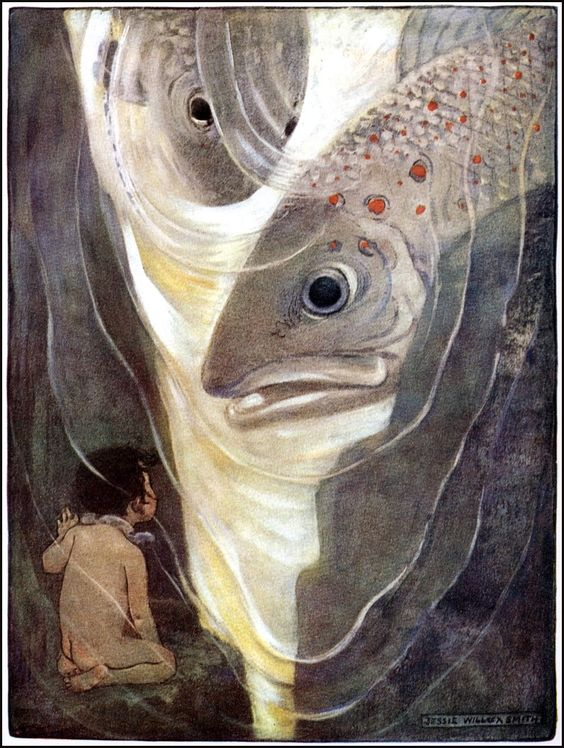
Illustration by Jessie Wilcox Smith from the fairy tale Water Babies by Charles Kingsley, 1862.
I chose this illustration because it depicts the strangeness of the situation we seem to find ourselves, or will in time, where the fish (representing Nature) looks aghast at the boy (representing us), who through greed and neglect raised the seas to levels where they could swim freely through our drowned cities.
And the boy, wearing gills, our future children, represents the hope that they will adapt in ways to survive the planet we leave them.
Discover more from Deborah J. Brasket, Author
Subscribe to get the latest posts sent to your email.

Thanks for caring and highlighting the climate crisis with these powerful and poignant poems Deborah. It is shocking and reprehensible that there are so many climate deniers. And yes, we also need to celebrate and appreciate the astounding beauty too. 🙏🌎
LikeLiked by 2 people
Thanks, Brad. We all have to do our part, only if it’s only to draw attention to the problem. As you have done too.
LikeLike
💔Yet, there is hope those ‘remembrances’ will offer healing balm, beauty & strength & as time ticks by and humanity doggedly strives to survive. The artwork you chose illustrates that unspoken idea, IMHO. 😦
LikeLiked by 1 person
Thanks Laura. I believe that too. And I’m hopeful we still have time to find technolical ways to mitigate the worst of it.
LikeLiked by 1 person
Such meaningful poetry, Deborah, and so unfortunate that it’s needed. The climate denial is ludicrous, and have you seen the reaction of the current US administration towards the wildfires in Canada? To quote a Facebook source, ‘He’s billing Canada for smoke. The same man who calls coal “clean and beautiful.” The same man trying to run pipelines through his own national forests while lecturing Canada on “Forest Management.” The same administration that just spent months quietly dismantling the government labs that research wildfire smoke.’ https://www.facebook.com/IFLOZ (scroll down the page to find the post) You really couldn’t make it up. 😦
LikeLiked by 1 person
I know, it’s so crazy and hypocritical what he’s saying and doing! We will have so much work to do to clean up after all the damage he’s done. Thanks Laura for sharing that link.
LikeLiked by 1 person
You’re welcome, Deborah. I just wish it wasn’t necessary … 😦
LikeLike
All three of these poems are very powerful. No one wants to play the Cassandra role, but the poets will keep on trying, keep on warning. (I’ve written a few climate change poems myself recently.) Remember the Cat Stephens song, “Where Do the Children Play?” from 1970?
LikeLiked by 1 person
I agree, Liz. I don’t remember that song but am going take a listen. I always liked Cat’s music.
LikeLiked by 1 person
It’s hard to fathom that we’re still fighting to save the planet 50+ years later.
LikeLike
thank you for these, they are reminders that we need to do anything we can to turn it around and consider what we are doing to harm the future
LikeLiked by 1 person
You are welcome Beth. It’s the least I can do, for whatever it’s worth.
LikeLiked by 1 person
every bit helps
LikeLiked by 1 person
Your poem is stunning, Deborah. Thank you for sharing. What we’re witnessing is hard to bear but I try to remain hopeful…that a tide will turn. And soon. Sending love, my friend, in solidarity. 💝
LikeLiked by 1 person
Thank you for the kind words about my poem, Vicki! It means a lot. Yes, I too think we will get through this. My faith is in the youth today and how much they care, and technology to counter the worst of it. Love to you too.
LikeLiked by 1 person
❤️❤️❤️
LikeLiked by 1 person
These poems are so beautiful and tragic, Deborah. It’s true that we have to take a moment to appreciate the Earth’s beauty while we can.
You’re right, we can’t say we weren’t warned. We’ve been hearing the warnings for decades. It’s beyond me how politicians and “supposedly” intelligent people continue to deny climate change and its impacts.
LikeLiked by 2 people
Thank you, Michelle. It is tragic that so many continue to deny is when its happening right now before their eyes.
LikeLiked by 1 person
Pingback: Cool summer reads in my July 2026 blog roundup - Boomer Eco Crusader