
Tags
a love story set during a revolution, Blood of Brothers, books about revolutions, Central America, Deborah J. Brasket, Guerrilla Warfare, how history repeats itself, Life and War in Nicaraugua, Nicaragua, Remembering Che, researching a novel, The Country Under My Skin, The Jaguar Smile, The Long Honduran Night, This Sea Within
My novel This Sea Within was inspired by my travels in Central America when sailing around the world. I loved the lush landscapes, the warmth of the people, and the culture of the countries we visited, even while troubled by the continual conflicts and political upheavals that took place there over the centuries and continues today.
We sailed into Panama’s St Andrews Bay on December 20, 1989, the same day the U.S. invaded the country. We watched from the deck of our boat while U.S. gunboats bombarded Panama City in their attempt to depose President Noriega and bring him to the United States to stand trial on drug charges. Hundreds of civilians were killed and an estimated 14,000 left homeless. When we finally were allowed to dock, the city was in shambles, all the stores empty and vandalized. The rubble and debris in the streets were piled so high that bulldozers were needed to clear them.
This wasn’t the first time the U.S interfered politically in the region. Ever since the Monroe Doctrine went into effect in 1823, establishing Central and South America as under the United States’ sphere of influence, it was used to justify interventions that led to much misery in the region. This led to the continual revolutions taking place there, and to so many people wanting to flee that terror by immigrating to the United States. You could say the “immigration problem” so many see today is rooted in U.S foreign policy.
I wanted to throw a light on that long, sordid history of propping up corrupt dictators to benefit American corporations.
Writing a historical novel takes a lot of research, even when set in the fictional country of San Balanque. Fortunately, it’s something I enjoy. My research focused on the revolution that took place in Nicaragua in the 1960s and 70s, one of the few examples where revolutionaries were able to throw out a corrupt dictator supported by the United States—in this case Anastasio Somoza.
At the same time, I was aware of how the new democracy in Nicaragua eventually devolved into another cruel dictatorship—this time, ironically and tragically, by Daniel Ortega, the leader of the revolutionaries who toppled Somoza.
The History and Politics of Revolutionary Warfare
Books that helped me better understand the history and politics of revolutionary warfare were:
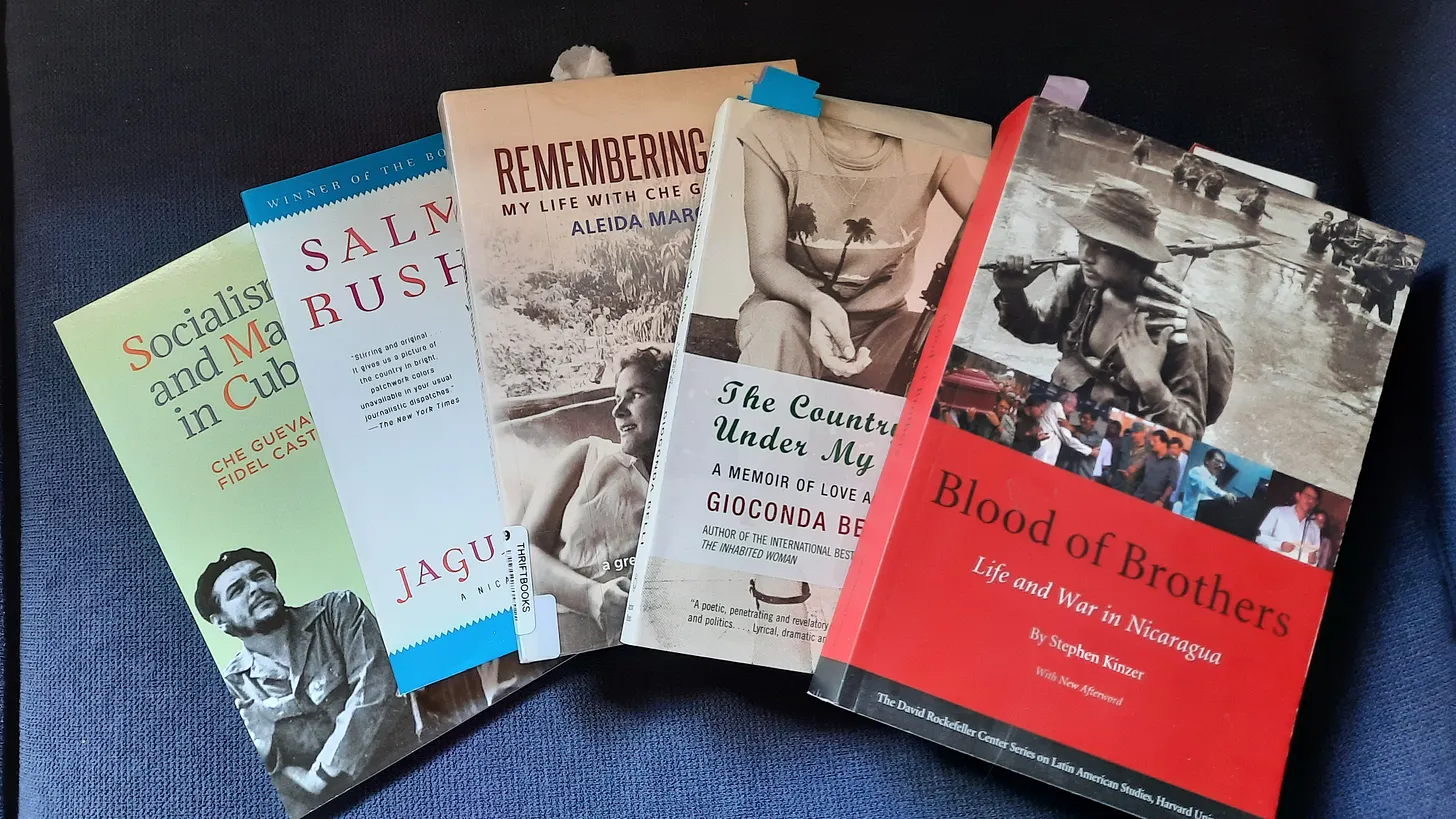
Blood of Brothers: Life and War in Nicaragua, by journalist Stephen Kinzer. Harvard University, 1991.
Kinzer writes in his Preface: “With the 2006 election of Sandinista Daniel Ortega, it is more important than ever to understand the roots of unrest and the U.S. role in perpetrating them. Deep poverty, inequality, ineffective governance, the legacies of conflict—these are current reminder of the issues that have torn a county apart repeatedly.”
The Jaguar Smile, A Nicaraguan Journey, by Salman Rushdie. Random House, 1977, 1987.
Rushdie wrote: “The Nicaraguan revolution had been, and remained, a passion. The word had secular as well as Christian resonances. It was the fusion that lay at the heart of Sandinismo.” I might add, at the heart of all revolutions, even the American Revolution that took place 250 years ago.
The Long Honduran Night: Resistance, Terror, and the United States in the Aftermath of the Coup, by Dana Frank, Professor of history at UC Santa Cruz. Haymarket Books, 2018.
Frank writes: “The fate of Honduras after the [2009 U.S. fronted] coup wasn’t a special case. It was a spearhead, cast into the emerging democracy throughout Latin America and the Caribbean.”
Becoming a Freedom Fighter
Books that helped me understand what it’s like to be a freedom fighter, especially from a woman’s point of view, or as a soldier in the field, were:
The Country Under My Skin: A Memoir of Love and War, by Gioconda Belli, a poet who became a revolutionary in Nicaragua. Anchor Books, 2003.
Belli writes: “I don’t know what came first—poetry or conspiracy. All my memories from that period are luminous, close-up images. Poetry was the result of that exuberant, life-giving spirit. Once I could assert my power and strength as a woman I felt able to shake the impotence our dictatorship made me feel, with all the misery it had sown. I no longer believed that change was impossible.”
Remembering Che: My Life with Che Guevara, by Aleida March, his second wife. Ocean Press, 2012.
March writes: “From the moment of that initial meeting [with Che at the guerrilla camp], without my even realizing it, my life took a certain direction and I never looked back . . . Surprisingly, I came closer to really knowing myself, not because I feared death, because we were always aware of it, but rather because I was always challenging myself about what had led me there and about how strong my commitment really was.”
Socialism and Man in Cuba, by Che Guevara and Fidel Castro. Pathfinder Press, 1989, 2009.
Che writes: “At the risk of seeming ridiculous, let me say that the true revolutionary is guided by great feelings of love. It is impossible to think of a genuine revolutionary lacking this quality. Perhaps it is one of the great dramas of the leader that he must combine a passionate spirit with a cold intelligence and make painful decisions without flinching. Our vanguard revolutionaries must make an ideal of this love of the people, of the most sacred causes, and make it one and indivisible.”
Guerrilla Warfare by Ernesto Che Guevara. CreateSpace Independent Publishing Platform, 2013.
Che writes: “It is important to understand that guerrilla warfare is a war of the masses, a war of the people . . . The guerrilla fighter needs full help from the people of the area. This is an indispensable condition. . . . [He] is a social reformer that takes up arms responding to the angry protest of the people against their oppressors, and he fights in order to change the social system that keeps all his armed brothers in ignominy and misery.”
Why This Sea Within is Relevant for Readers Today
Democracy is under assault everywhere today, even in these United States.
While I was writing This Sea Within, Russia invaded Ukraine. I followed the story closely, appalled by what was happening there, but also deeply inspired by the leadership of President Volodymyr Zelensky and the bravery of the Ukrainians who defended their democracy against against a corrupt dictator, Vladimir Putin, with a much larger force. Their struggle informed my writing and made This Sea Within seem even more relevant for today’s readers.
Before This Sea Within was published, the United States under President Trump invaded Venezuela and kidnapped President Maduro, bringing him to the U.S. to stand trial on drug charges. Then President Trump made a deal with the remaining leaders of the corrupt regime to bring in American corporations to take over their oil industry.
So history repeats itself. The cyclical nature of “peace and plunder” as written about in my poem “This Sea Within All Things” continues down through the ages—even while “strong arms and stalwart hearts” rise up to resist the maelstrom, again and again.
We can learn from those revolutionaries who came before us, even those who fought 250 years ago.
“The liberties of our country, the freedom of our civil Constitution, are worth defending at all hazards; and it is our duty to defend them against all attacks.
We have received them as a fair inheritance from our worthy ancestors: they purchased them for us with toil and danger and the expense of treasure and blood, and transmitted them to us with care and diligence.
It will bring an everlasting mark of infamy on the present generation, enlightened as it is, if we should suffer them to be wrested from us by violence without a struggle, or to be cheated out of them by the artifices of false and designing men.” —Samuel Adams
It does not take a majority to prevail . . . but rather an irate, tireless minority, keen on setting brushfires of freedom in the minds of men. —Samuel Adams
Our cruel and unrelenting enemy leaves us only the choice of a brave resistance, or the most abject submission. We have, therefore, to resolve to conquer or to die. —George Washington, August 1776
This Sea Within
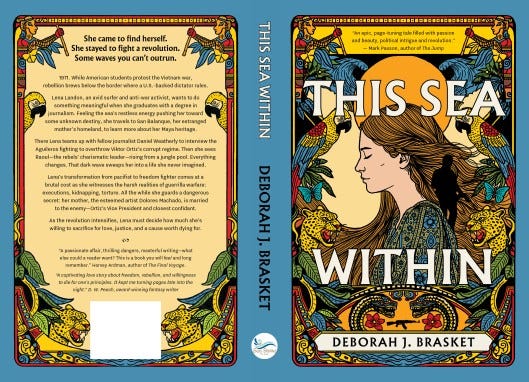
She came to find herself. She stayed to fight a revolution.
Some waves you can’t outrun.
What early readers are saying
“A stirring reminder that love lies at the heart of every revolution, This Sea Within by Deborah J. Brasket is a coming-of-age drama set against the civil unrest and rebellious spirit of the Yucatan Peninsula in the early 1970s. The prose is marked by lyrical imagery and visceral depictions of exotic landscapes, along with an unflinching dive into taboo ideas, making this an impressively timely and radical read, no matter the historical setting.” SPR Review
“For those looking for well-written, epic protest literature that delivers a mesmerizing climax. Deborah J. Brasket captivated me with the seductive allure of an idealism of a powerful revolution and how it connects with nuanced morality. Fans of The Red Sparrow trilogy and The Kite Runner will enjoy how this book explores the way personal passion becomes inseparable from the cataclysm of history.” Readers’ Favorite ★★★★★
“A bold story about passionate people fighting for what they believe in, This Sea Within is an intimate coming of age novel perfect for readers who appreciate artful, poetic fiction with the highest stakes.” Nicky Flowers, Indies Today ★★★★★
Ready for Pre-order on Amazon, Barnes and Nobles, Bookshop. Release Date, June 15
Discover more from Deborah J. Brasket, Author
Subscribe to get the latest posts sent to your email.

Kudos on the extensive research you did Deborah. Sadly, we don’t seem to have learned from our mishaps in central and south America.
LikeLiked by 1 person
Thanks, Brad. Yes, it is sad, and I don’t hear others talking about how we need to change that.
LikeLiked by 1 person
Great post. So interested in the round-up of relevant titles. I appreciate your recap of US interventions – often at the time I did not understand them or was not politically savvy and informed enough to make sense of it all. Such a perilous time in the US right now.
LikeLiked by 1 person
I appreciate that, Valorie. I didn’t become political until later in life. I always voted, but didn’t pay that much attention to what was going on beyond the headlines. That began when I started teaching. And reading Chomsky, The Nation, and Mother Jones. Now you rarely hear of those names, but what they wrote about still have legs.
LikeLiked by 1 person
this does sound so relevant to our current state of things here. you put a lot of time in with the research and love the list and it sounds like you learned a lot along the way
LikeLiked by 1 person
Yes, it is still sadly so relevant. I wonder if we’ll ever learn. I remember how the cry “Never again!” seemed like we truly had learned something, really would never let something like the holocaust happen again. Then came Gaza, and now Lebanon, and no one stopping it. Even in Ukraine–you’d think we wouldn’t have allowed Russia to invade, let along bomb civilians and schools and hospitals and essential infrastructure–all war crimes. We have the power but not the will to stop these things, it seems.
LikeLiked by 1 person
we need to change that –
LikeLike
Thanks for the history lesson, Deborah. There is so much corruption in the world, and right here at home. I look forward to reading your book.
LikeLiked by 1 person
Thank you, Michele! I hope you enjoy it.
LikeLiked by 1 person
Im on board, Deborah. I am so excited to read this. Always been a student of Latin America and Caribbean history. Especially imperial ambitions in the region. Im in… so in.
LikeLiked by 1 person
Aw that’s so great to hear! I’m so glad you’re in. I’d love to hear what you think when you get a chance to read it.
LikeLiked by 1 person
You most certainly will. I Pre-ordered, so I will be reading as soon as it drops.
LikeLiked by 1 person
This very informative post shows the fascinating results of your intensive research, Deborah!
LikeLiked by 1 person
Thank you, Tim. I enjoyed the research.
LikeLiked by 1 person
😍
LikeLike
Beautiful!
LikeLiked by 1 person
Thank you!
LikeLike
This is a deeply powerful and meaningful foundation behind This Sea Within it carries real lived experience, history, and reflection, not just fiction. From witnessing Panama during the 1989 invasion to researching Nicaragua, Honduras, and revolutionary movements, you’ve woven personal memory with political history in a way that gives the novel real weight and urgency. The way you connect past interventions, modern conflicts, and the human cost of power makes the story feel both grounded and timely. It’s clear the book isn’t just about revolution it’s about people, choices, survival, and the repeating patterns of history.
Wishing you strength and success as This Sea Within reaches readers on June 15.
LikeLiked by 1 person
Thank you so much, Anawar, for your thoughtful response and well wishes. That means a lot to me.
LikeLiked by 1 person
It’s my pleasure 😊❤️
LikeLike
I visited Havana, Cuba, in 2000 as part of a medical mission. The remnants of the revolution were still apparent, including the Museum of the Revolution. I sat through three hours of a five-hour speech given by Fidel Castro and attended a conference on the U.S. embargo. I’ve read the writings of Guevara and Castro. My knowledge of the Cuban revolution and its aftermath prompted me to read your book. I didn’t know this at the time, but my father later told me that the U.S. Army sent him to Cuba on a secret mission in the 1950s. I thought your book captured the “flavor” of a revolution very well. I look forward to the second book in the trilogy.
LikeLiked by 2 people
How interesting, your trip to Cuba! And also how that prompted you to read my book. I’m so happy you thought it captured the flavor of a revolution. All that research paid off, it seems! I’m looking forward to getting back to writing that 2nd book.
LikeLike