Tags
a mesmerizing read, book review, Flash Fiction, Hunting the Cosmos, Luanne Castle, poetry, poetry about art, Remedios Varo, surreal art
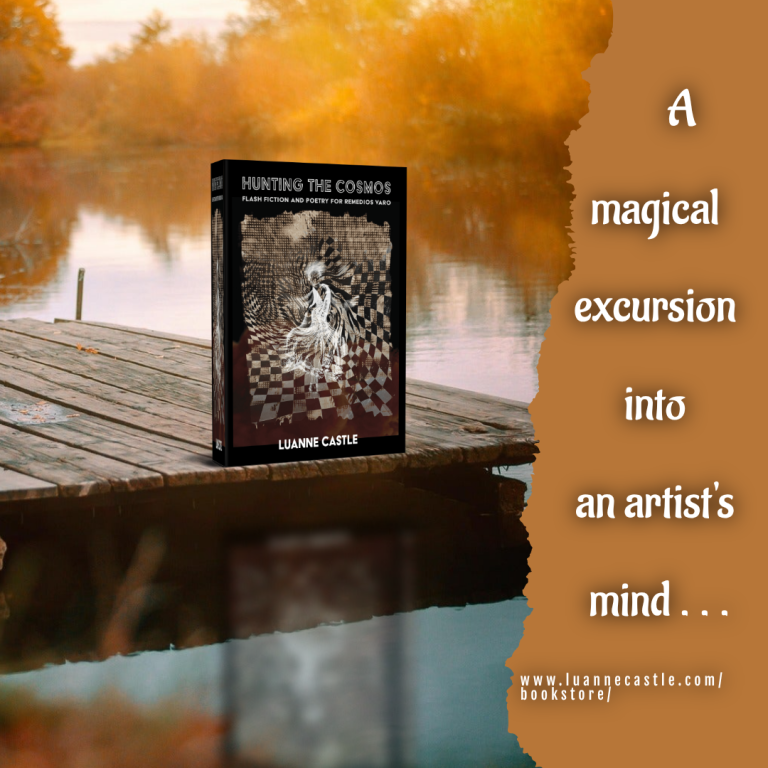
Like the Beatles song, Luanne Castle’s latest book Hunting the Cosmos is “a magical, mystery tour waiting to take you away.”
It’s a mesmerizing read of poetry, prose poems and flash fiction that channel the surreal paintings of Remedios Varo, taking the reader into mysterious spaces where all is uncertain, suggestive, left open to interpretation.
Many of the poems appear to be as inscrutable as the artwork that inspired them. But neither the artist nor the poet asks to be understood, but intuitively felt, emotionally experienced.
Many are dreamlike in the way that our dreams can be so frustratingly fascinating because open to interpretations that can never be verified. And yet we recognize them as meaningful, as having something important to relate.
Other pieces are humorous, playful, even mocking. Or ironic and satirical. Some are takedowns of patriarchy and dogma and poetry itself.
But is this all too elusive? Let’s take a closer peek inside.
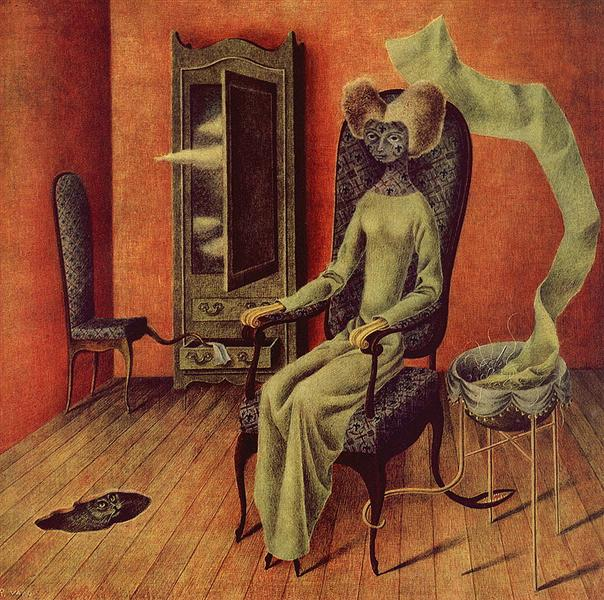
In Mimesis or Mimicry, the narrator says: “I have become the focus of my tabby cat, Mimesis . . . She is watchful, always napping or hiding near me, as if she can sense clandestine movement and the appalling trajectory of my life.”
What she watches is how this careful, inactive person slowly becomes her surroundings, wooden legs and arms. Is this a critique of, or warning to, the passive inactive reader, the armchair voyeur? Or artists in general who become immersed in their own imaginations? Who knows?
Many of these stories and poems act as Rorschach inkblots: Our interpretations revealing our own emotional states or unconscious conflicts. (So what might this interpretation say about this reader, hmm?)
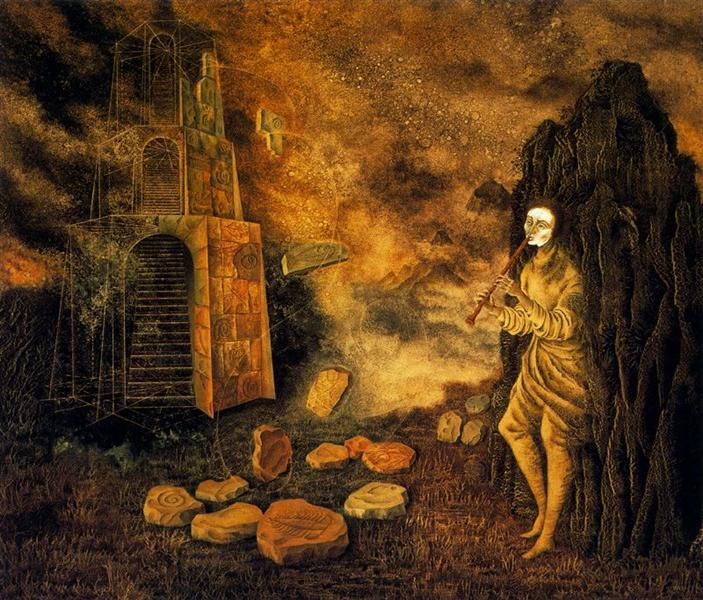
Who Is that Mysterious Flautist? opens with: “A crow landed on my mother’s chair at breakfast, causing her to roll her eyes and slump over dead. Rather than call 911, I decided to cement her into the ground in a weedy area behind a dead tree.” From that weedy area a tower rises “where I’ve ditched all my problems.”
The tower grows and grows and then a mysterious flautist appears. The narrator screams “stop, stop” when the music’s vibrations threaten to send the tower tumbling. “You are ruining my powerful tower, the keep of chaos.” We learn at the end the name of that mysterious player: Guilt.
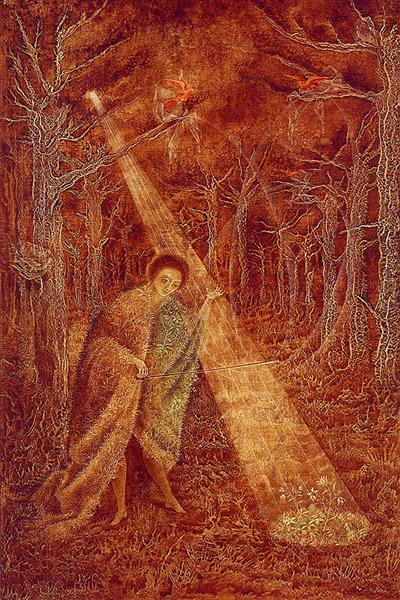
My favorite may have been Mentor in the Woods inspired by Varo’s painting Solar Music. It starts out: “Sylvie was walking alongside Old Ven [her horse] when she saw red birds circling her forward, and then circling her again, as if to lead her.” Since her brothers were being tutored and she, “silly girl,” wasn’t allowed to join them, she follows the birds to a meadow.
There met a woman called Varo, “who held a fiddlestick, and with a peaceful expression played the sunrays fanning out to spotlight the hidden wildflowers.” She gives her bow to Sylvie. “That’s when she begins to “really hear the music because she had created it herself.”
“Smiling at Sylvie’s shiny eyes and rounded mouth, Varo nodded and faded away.” Sylvie plays her music, dancing in the sunrays, and discovers she doesn’t need the bow: She can play the sun with her fingers. Returning home, she knows she will create “new compositions in her head that night in bed.” For me, this story is about discovering that your own power to create lies within yourself, apart from society’s hampering strictures.
I also wonder if the poet who created this story (Castle) was saying something about her relationship to Varo’s paintings. She was handed the artist’s bow (her paintings) and began playing with them. But it was only when she began to create her own stories about them that she really “heard” the music (of the paintings) because “she had created it (the music she found in them) herself.”
Or is this me, the reader, the reviewer, who learned to hear the music of these paintings and poems because I myself picked up the bow of creativity handed to me to create my own interpretations of them?
Either way, this is only one beautiful example about how one artist inspires another and then another and then on and on from there.
I highly recommend this book for lovers of surreal artistry in poetry and prose. You won’t be disappointed.
Purchase Hunting the Cosmos at Shanti Arts, Amazon, Barnes and Nobles, and Bookshop.
ABOUT LUANNE CASTLE

Hunting the Cosmos is Luanne Castle’s sixth book. She has published four award-winning poetry collections and Scrap: Salvaging a Family, a memoir in flash. Her poetry and prose have appeared in Copper Nickel, River Teeth, Your Impossible Voice, JMWW, Grist, Fourteen Hills, Verse Daily, One Art, Lunch Ticket, Saranac Review, Pleiades, The Ekphrastic Review, The Mackinaw, Thimble, Flash Boulevard, Cleaver, Moon City, Moon Park, Anti-Heroin Chic, Bending Genres, BULL, and more. Her mixed media collages have been published in many journals.
You can learn more about Luanne and her books at Luanne Castle: Poetry and Other Words (and cats!) and on Substack
ABOUT REMEDIOS VARO (1908 – 1963) – One of Mexico’s most beloved artists, Remedios Varo created artworks resembling richly detailed puzzles that link ideas from Surrealism, magic, alchemy, astrology, and psychology. You can read more about her life and artwork HERE
Find out more about my novels HERE
Discover more from Deborah J. Brasket, Author
Subscribe to get the latest posts sent to your email.

Wonderful review Deborah. Luanne’s book and verse sound very poignant and intriguing.
LikeLike