
Tags
A Prodigal Turns Prophet, Asian Art Museum, coming home to ourselves, Deborah J. Brasket, Derek Walcott, enlightenment, inspiration, life's journey, Love After Love, poetry, Spirituality, Taoism, The Prodigal Son, Zen Buddhism
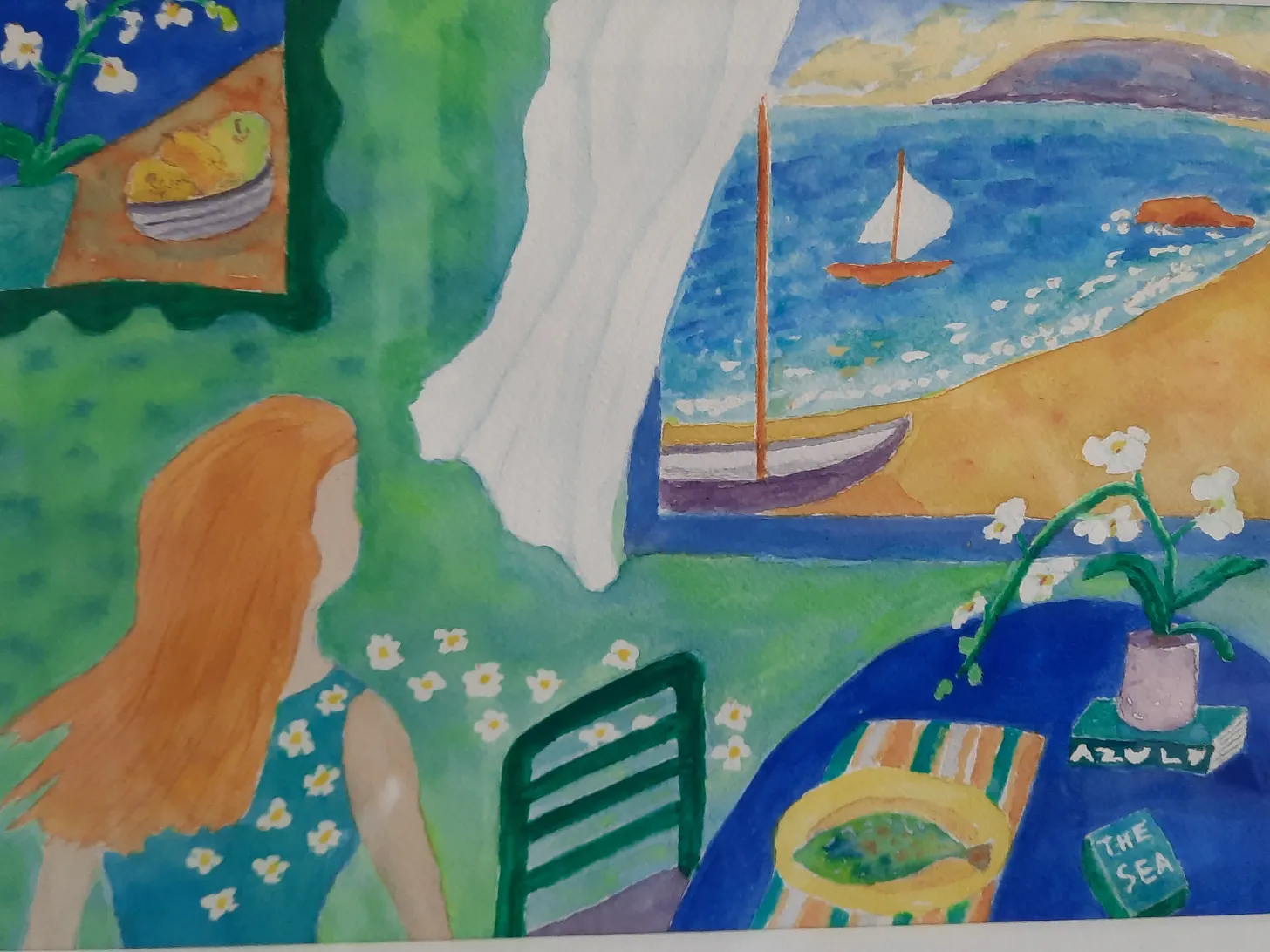
Love After Love
by Derek Walcott
The time will come
when, with elation
you will greet yourself arriving
at your own door, in your own mirror
and each will smile at the other’s welcome,
and say, sit here. Eat.
You will love again the stranger who was your self.
Give wine. Give bread. Give back your heart
to itself, to the stranger who has loved you
all your life, whom you ignored
for another, who knows you by heart.
Take down the love letters from the bookshelf,
the photographs, the desperate notes,
peel your own image from the mirror.
Sit. Feast on your life.
Reading this poem moved me deeply. One wonders if the whole purpose of our life journey is to lead us to that place where we see ourselves, finally, “face to face,” and greet ourselves with love and elation in this ultimate homecoming.
I’m pairing Walcott’s poem with one of my own, about another, or similar, kind of homecoming.
A Prodigal Turns Prophet
Three summers I spent by the river in the heat of a homeless camp. (Having left my father’s home, which was my home, though I knew it not.)
Three summers of night terrors howling through my tent as the stars threw down their furious spears. (Having left my mother’s home, which was my home, though I knew it not.)
Three summers trolling the streets in blistered feet while eyes turned sideways at my glance. (Having lost all I loved, which loved me still, though I knew it not.)
As I walked the flesh melted from my bones, my teeth melted from my mouth. My thoughts dried up and blew away. Past and present dried up and blew away.
Nothing was left behind to claim a name, to know what I was or wasn’t.
Empty, careless and carefree, I danced along the street like a wind-tossed leaf, like a moon-mad fool, marveling at how all I saw danced with me.
Now my tent is my temple and the river flowing past me washes through me—mother and father and all I love and always was and ever will be.
Now as I walk the streets flowers grow at my feet, and every eye turned toward me is mine.
By Deborah J. Brasket
I wrote this poem with my son in mind, who, if you read my essay My Wild Child, My Son is on a difficult journey through life.
The story of the Prodigal is a favorite found in almost every faith because it tells deep truths we all recognize. We are all prodigals in some ways, whether living homeless on the streets or in the home of our dreams, if we have not, as this Prodigal has, returned home to our true self. If we have not gone through the weaning process that strips us of all we never were and gives back to us all we are, the magnificence of our oneness with the All-in-all.
This poem, too, is influenced by the tales of the old Zen Masters, relating their journey to enlightenment, a process known as “losing and losing.” Often they began their journey in abject poverty. Chuang Tzu describes how he was able to free himself from the limitations of the finite mind and gain an insight into his innermost being: First freeing himself from the concerns of the world, then from all externalities, from gain and loss, right and wrong, past and present. Finally he was freed from his own existence, from birth and death, I and Other. He sees the One and becomes part of the One. At that point, he was able again to enter again into the world of men, but this time with “bliss-bestowing hands.”
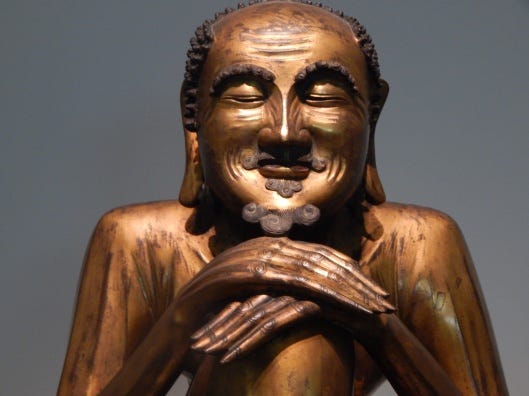
The photo above is one I took at the Asian Art Museum in San Francisco. I wrote a blog post about that visit called “Fascinating Faces, Tao and the Arts.”
I wrote: “Some works of art speak to you on a level that is hard to define. You gaze and are drawn inward. Something in you identifies with what you see there. It’s not outside, it’s in here. It was there before you saw it, and the seeing is just a reminder of its presence.” I felt a special affinity with this face.
I paired that face, that smile, with this Zen story:
Once there was a monk fleeing for his life, a tiger at his heels, chasing him over the edge of a cliff where he grabs hold of a branch. He dangles there just out of reach of the tiger’s snapping jaws, while below another tiger is snapping at his feet. No escape. Just then he notices a fat juicy strawberry dangling from a nearby vine. He plucks it loose and pops it into his mouth. “Oh, so delicious!” he sighs.
When Things Go Missing
A mother vanishes, a family unravels.
Three journeys to wholeness unfold in this poignant & propulsive tale of love and longing.
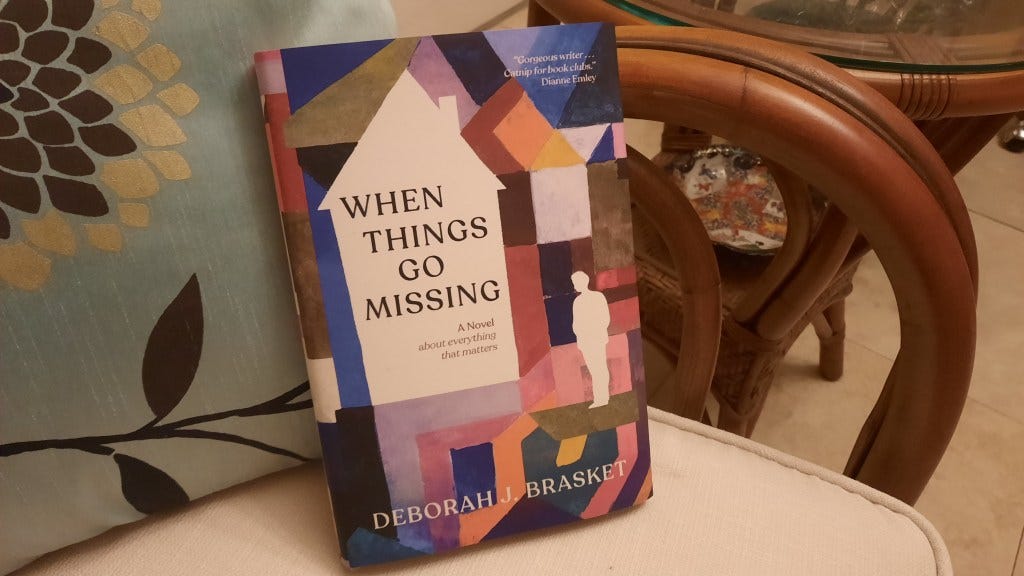
“A powerful novel about losing yourself in order to find a way home, When Things Go Missing by Deborah J. Brasket is an achingly poignant exploration of femininity, responsibility, and liberation from societal expectations. Featuring sharp, emotional storytelling and painfully flawed characters traversing profound developmental arcs, this subtle but profound novel is a testament to choosing your own path, no matter how strange the road.” SPR Review, ★★★★★
Get your copy at at Amazon, Amazon UK, Amazon AUS, Bookshop, Barnes & Noble and other major outlets. Available in ebook, paperback, and hardcover formats.
Discover more from Deborah J. Brasket, Author
Subscribe to get the latest posts sent to your email.

I have always loved “Love After Love” and your response to it is wonderful, Deborah.
I read the story regarding your son and am awestruck and hope only for the best for him and his family and you. My goodness…
I was going to say I have a daughter going through stuff but nothing like this. A very different kind, though.
Being a mother is something we can never truly picture, is it?
LikeLiked by 2 people
Thank you so much, Dale. Yes, being mother is the hardest and most rewarding joy I think any of us can have. But it is so heartbreaking when a loved one is suffering and nothing you do seems to help. At some point you have to step back and trust that they will find their way on their own.
LikeLiked by 1 person
I hear you – loud and clear.
LikeLiked by 1 person
Oh a parent’s job is so tough. We never really stop worrying — do we? Love this person exe and your other one on your son. Beautiful tributes.
LikeLiked by 1 person
So true, Brian. I’m so glad you enjoyed those tributes. Each child has their own journey to take, their own strengths and weaknesses, and yet each brings so much joy and love into my life, despite that worry.
LikeLike
What a touching and evocative poem you wrote Deborah. And Derek’s too. Both remind me of the transient nature of life, and maybe the purpose of life is to meet ourselves in the mirror with love and acceptance.
LikeLiked by 1 person
Thank you , Brad. That means a lot, and you are so right about meeting ourselves with love and acceptance.
LikeLiked by 1 person
😊
LikeLiked by 1 person
Fascinating poetry, Deborah. The tales of the old Zen Masters must be a good influence.
LikeLiked by 1 person
I’m glad you enjoyed them, Tim. Yes, I love that Zen story and so many others. So much to teach us.
LikeLiked by 1 person
i love both of the poems, finding oneself when it has been there the whole time. the poem of your son i beautiful and bittersweet, being a mother can be so very hard at times, and the hardest thing to do is to let it play out.
LikeLiked by 1 person
I’m so glad you loved these, Beth. And yes, stepping back and letting it play out is the hardest things to do.
LikeLiked by 1 person
I think I agree, Deborah; we get so swept up into the world around us that it’s easy to lose our sense of self, or be prevented from accessing it through the needs and demands of others. When we’re able to shed the rest, then we’ll be able to truly see ourselves. I need to read your essay to fill in the background of your own poem, but for now it puts me in mind of Cal, from your ‘When Things Go Missing’, who lives a difficult life unmaking himself before he can rebuild. Many thanks for this post. 🙂
LikeLiked by 1 person
Thanks, Laura. Yes, I see a lot of my son in Cal. The good parts for sure. Writing that book was cathartic in a way. I couldn’t have written about my own family’s experience with addiction, but filtering it through another family actually gave me insights I hadn’t been aware of before.
LikeLiked by 1 person
That’s a wonderful part of being a writer, I think. Using our own experiences, writing them down in our characters, works not only as therapy but helps us to distance them enough to be able to see them more clearly. I’m glad for you that you were able to help process a painful part of your life in this way.
LikeLiked by 1 person
A very enjoyable post! Thank you for the painting and the two poems.
LikeLiked by 1 person
Thanks, Liz!
LikeLiked by 1 person
You’re welcome, Deborah!
LikeLiked by 1 person
I have always loved Derek Walcotts writing. He was almost mandatory reading growing up in the Caribbean. I was very moved by your piece about your son. It is very difficult as a parent to know when to release the reins and watch them navigate life. Always wanting to intervene but knowing there isn’t much one can do. Thanks fornthe share, Deborah.
LikeLiked by 1 person
Where were you living in the Caribbean? I understand Walcott was from St. Lucia. We visited there and other places in the Caribbean when we were sailing so many years ago. I loved it!
Thank you for your kind words about my son.
LikeLiked by 1 person
Hi Deborah. I am from Trinidad. I grew up there, and most of my family still live there. Yes, Walcott is St. Lucian… but West Indians celebrated him in general. We all claimed him as ours 😆
LikeLiked by 1 person
We never made it to Trinidad. But I’d love to go there someday.
LikeLiked by 1 person
Trinidad is as far south as you can go in the Caribbean. I’d love to see your post about the island when and if you get the chance to visit.
LikeLike
That Derek Walcott poem is a favorite of mine. (The Marginalian often insists I read it again!) Your response is poignant. Dinner is about ready, so I will return to read the essay later!
LikeLike
A wonderful post, Deborah!
LikeLiked by 1 person
Thanks, Dawn!
LikeLike