
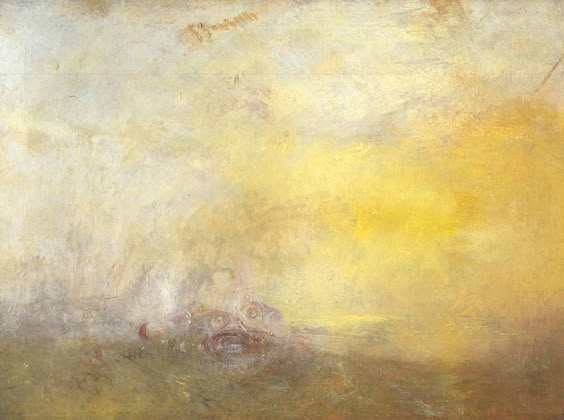
Sunrise with Sea Monsters by JMW Turner
I am happy to report that at least in one very narrow slice of life, truth and love has indeed won. If you read my original post, the whole thing started with me ruminating about a nasty custody battle, and my fervent hope that “truth and love” would win in the end. It did. The judge was not persuaded by all the lies (easily proven) that were slung against my son, and the eventually ruling favored him, while benefiting the mother as well. A win-win, as I see it, and hope that she does too.
On the political front, I’m still hopeful that “truth and love” will win in the end, and there is evidence that this is bearing true.
But the problem with “winning” is that it splits us all into two camps: the winners and the losers. And when that happens, no one really wins, at least for long. The pendulum will keep swinging back and forth between the two camps.
In reality, truth and loves “wins” only when there are no losers and winners, when there is only the common good. As a nation we seemed to have moved far away from that once common goal. In fact, the whole notion of a “common good” seems to be in ill repute.
In the struggle between rugged individualism and the common good, a struggle which gave rise to our nation, rugged individualism seems to be winning out. “Rugged individualism” even sounds way cooler than the tepid “common good.” Who wants to be “common,” after all? Or “good”?
During an earlier age of Enlightenment and Reformation, “the common good” was a revolutionary idea:
Saint Thomas Aquinas held “the common good” (bonum commune, in Latin) to be the end of law and government; John Locke declared that “the peace, safety, and public good of the people” are the ends of political society, and further argued that “the well being of the people shall be the supreme law”; David Hume contended that “social conventions” are adopted and given moral support in virtue of the fact that they serve the “public” or “common” interest; James Madison wrote of the “public,” “common,” or “general” good as closely tied with justice and declared that justice is the end of government and civil society; and Jean-Jacques Rousseau understood “the common good” (le bien commun, in French) to be the object of a society’s general will and the highest end pursued by government.
The “common good” and ‘”good government” were one in the same:
Though these thinkers differed significantly in their views of what the common good consists in, as well as over what the state should do to promote it, they nonetheless agreed that the common good is the end of government, that it is a good of all the citizens, and that no government should become the “perverted servant of special interests,”[10] whether these special interests be understood as Aristotle’s “interest of the rulers,” Locke’s “private good,” Hume’s and Madison’s “interested factions,” or Rousseau’s “particular wills.” Wikipedia
But we live in troubled times and good ideas cycle in and out of favor. Self interest and serving special interests seem to be winning the day. And so there will be no peace.
Jane Addams, the first American woman to win the Nobel Peace Prize in 1831 wisely cautioned: “The good we secure for ourselves is precarious and uncertain until it is secured for all of us and incorporated into our common life.”
I’m hoping for the sake of peace in my family, and our nation, that a “common good” will be secured for all of us.
Discover more from Deborah J. Brasket, Author
Subscribe to get the latest posts sent to your email.

I’ll take even the small wins for truth and love. I’m starting to believe that over the next few years it will be the common folk–and our own wisdom–that will change the world for the better rather than ego-filled world leaders. (Not all, mind you. But enough are ego filled!) So glad it worked out for your son and his family. Wishing you a happy holiday!
LikeLike
I hope you are right, Kay. I tend that way too. Have a lovely holiday!
LikeLiked by 1 person
I am happy for you, your son and his family and I am grateful to you for the wisdom you share in this post.
LikeLike
Thank you, Catherine. It was a tremendous relief.
LikeLike
Glad that things have been peacefully resolved. Hope you all have a wonderful Christmas.
LikeLike
Wishing you and Gary a wonderful Christmas, too!
LikeLike
I just knew something good was brewing from your response to my comment on your last post…
– huge sigh of relief –
take care (he)artist friend
LikeLike
I really appreciated your comment, Laura, checking up on the case. It spurred me to create this update post. So I thank you for the inspiration! Have a wonderful holiday, flower-sister.
LikeLike
Deborah, thanks for reminding me of our ‘snappy’ connection!
😉
LikeLike
I think we are connected in a couple of ways, aren’t we. Don’t we share a birthday too, October 18?
LikeLiked by 1 person
Yessss! It was named ‘sweetest day’ in the ’60s I believe, after us, right?!!
LikeLike
I hadn’t heard of the “sweetest day”! God bless the 60’s!
LikeLike
I appreciate your post. I had a different win/lost this year that caused a lot of hurt, so I appreciate your post. Is there a way I could share this on facebook?
LikeLike
If this post helped you, Patricia, I’m so glad. I’d love for you to share your experience here, as a comment, if you’d like.
LikeLike
Your message touched me. I hope for the same ability to find common ground, somehow. And I am glad your family situation has worked out.
LikeLike
Thank you, Claudia. I hope things work out for you too.
LikeLiked by 1 person
Deborah, I’m so glad things worked out, and especially in time for the holidays. Hope you had plenty of good time with family and friends.
LikeLike
Thank you. Dale and I had a lovely Christmas with my son and granddaughter. So much to be thankful for.
LikeLiked by 1 person