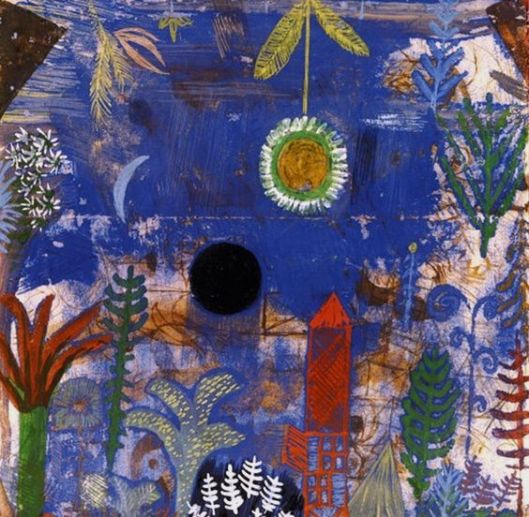
Paul Klee, Versunkene Landschaft, 1918
Wallace Stevens once famously said: “You can’t get the news from poems, but men die every day for lack of what is found there.”
It may be hard to argue the truthfulness of that statement when we consider the widespread unpopularity of reading poetry. A recent study finds that “since 2002, the share of poetry-readers has contracted by 45 percent—resulting in the steepest decline in participation in any literary genre.”
Poetry, it appears, is less popular than knitting, jazz, and dance. Perhaps that’s why we need the month of April to celebrate poetry, to help curb the decline and rekindle a comeback.
But Stevens wasn’t arguing that we die from the lack of reading poetry, but from the lack of what is found in there, the thing that inspires poets to put pen to paper, and artists to pick up their brushes, and musicians to play their instruments.
The thing we find in poetry that saves us, that renews us, that keeps us from dying for lack of, is the “poetry” we find in life, in nature, in human experience. In our deepest feelings and highest aspirations. So much of written poetry is about that, discerning the poetry in ordinary life, in things forgotten and overlooked and dismissed, and unfurling it in words on paper for all to read.
The ability to see poetry in all the aspects of our lives is what saves us. We don’t have to be poets to see the beauty, symmetry, grace in our surroundings, the imperfect perfection of ordinary things; to discern the repetitions in patterns, the rhymes and rhythms that surround us, to hear the alliteration, and the way assonance and dissonance complement and complete each other; to understand the contradictions and similarities of things, the subtle differences and deep complexities, to appreciate the humor and irony, the paradox and profundity that weaves itself through our lives.
In all of this is the poetry that poets write about. It’s what makes life rich and diverse and meaningful. It’s what moves us toward compassion and forgiveness, and inspires us toward greatness, and fills us with hope and humility.
The discernment and appreciation of the subtle and glorious intricacies of this grand tapestry in which we are woven–this is what saves us.
And this is what we find in reading poetry, if it is poetry at all.
I’ll leave you with the following poem.
Poetry
by Pablo Neruda
And it was at that age . . . Poetry arrived
in search of me. I don’t know, I don’t know where
it came from, from winter or a river.
I don’t know how or when,
no, they were not voices, they were not
words, nor silence,
but from a street I was summoned,
from the branches of night,
abruptly from the others,
among violent fires
or returning alone,
there I was without a face
and it touched me.
I did not know what to say, my mouth
had no way
with names,
my eyes were blind,
and something started in my soul,
fever or forgotten wings,
and I made my own way,
deciphering
that fire,
and I wrote the first faint line,
faint, without substance, pure
nonsense,
pure wisdom
of someone who knows nothing,
and suddenly I saw
the heavens
unfastened
and open,
planets,
palpitating plantations,
shadow perforated,
riddled
with arrows, fire and flowers,
the winding night, the universe.
And I, infinitesimal being,
drunk with the great starry
void,
likeness, image of
mystery,
felt myself a pure part
of the abyss,
I wheeled with the stars,
my heart broke loose on the wind.
Discover more from Deborah J. Brasket, Author
Subscribe to get the latest posts sent to your email.

“…and suddenly I saw
the heavens
unfastened
and open,…”
as if life is an open-sourced poem ready to be coded, written, shared.
Excellent ~ thank you!
LikeLike
I love the way you put that, life as an open-sourced poem ready to be written! Thank you for sharing that.
LikeLiked by 1 person
“And I, infinitesimal being,
drunk with the great starry
void,
likeness, image of
mystery,
felt myself a pure part
of the abyss,
I wheeled with the stars,
my heart broke loose on the wind.”
Oh yes, this is what poetry does to us! I love this post, Deborah. It hits the spot in so many ways. Beautiful word weaving that captures the essence of art, life and poetry. Thank you! xo
LikeLike
Thank you, Joy. I too feel that way when I write poetry. And thank you for sharing this on FB.
LikeLike
Poetry is about hearing, seeing, listening to insight beyond our own, and empathy. Clearly, the world needs more of it. Thank you for writing and sharing this beautiful perspective.
LikeLike
Thank you, Laurie. I appreciate that, and agree with you.
LikeLike
A profound thought from Wallace Stevens, an amazing poem and a gorgeous painting, stuffed with meaning and poetry…
Another blogger also wrote about poetry the other day, and I have been stewing over the subject too… one of the things that sadden me is that children grow up with no understanding of rhythm, and rhythm has always seemed to be is so much a part of life, from the passing of the seasons, the rising and setting of the sun and the moon, the repetition of women’s cycles, and the regular movement and rhythm of all life..
In times of crisis, the rhythms of poetry have helped me through… but children no longer have an underlying understanding of that precious gift, it seems to me..
The paragraph “The ability to see poetry in all aspect of our lives” was exquisitely written, and exquisitely true… I read and re-read it for its beauty and insight… wish I had written it…thank you…
LikeLike
Thank you, Valerie. I agree about the rhythm and rhyme, and do believe it’s in our DNA to respond to that and to seek it out in nature,in which it is abundantly evident. I loved nursery rhymes as a child, and even now. And of course we see a lot of that in our contemporary music, love songs, etc. It’s hard to find a place where you don’t see it!
LikeLike
Reblogged this on sketchuniverse and commented:
😍 “MY EYES WERE BLIND, AND SOMETHING STARTED IN MY SOUL” (“Mis ojos estaban ciegos, y algo empezó en mi alma”). OH DARLINGS , THESE WORDS BY PABLO NERUDA WITH THE WORK BY KLEE, ARE IN MY OPINION PURE PLEASURE.
LikeLike