
Tags
David Abram, Language, Maurice Merleau-Ponty, Niels Bohr, Personification, Physics, Werner Heisenberg
 The personification of nature and inanimate objects is age-old, something we humans have done as far back as we remember.
It may be an elemental part of who we are, to see something of ourselves in the world around us. To infuse the other with parts of ourselves. Chairs have arms and legs, clocks have faces and hands. Leaves whisper, kites dance, winds caress, storms rage and die.
We think of personification and other rhetorical devices as tools, something we use to describe the world in terms our reader can understand or empathize with. But maybe it’s more instinctual than that. Maybe it’s a type of knowing. Knowing the other as ourselves. Knowing there’s no true separation between ourselves and the world around us.
 Perhaps it’s an uncanny acknowledgement of our interconnection and interdependence. A way of knowing the world as a larger body, or embodiment, of ourselves.
And perhaps by opening that door, we allow the other inside us, where it too finds a larger embodiment of itself, dwelling in our minds, our words, our stories.
“Language is the very voice of the trees, the waves, and the forests,” writes phenomenological philosopher Merleau-Ponty in The Visible and Invisible.
 David Abram in his Spell of the Sensuous expands upon this idea:
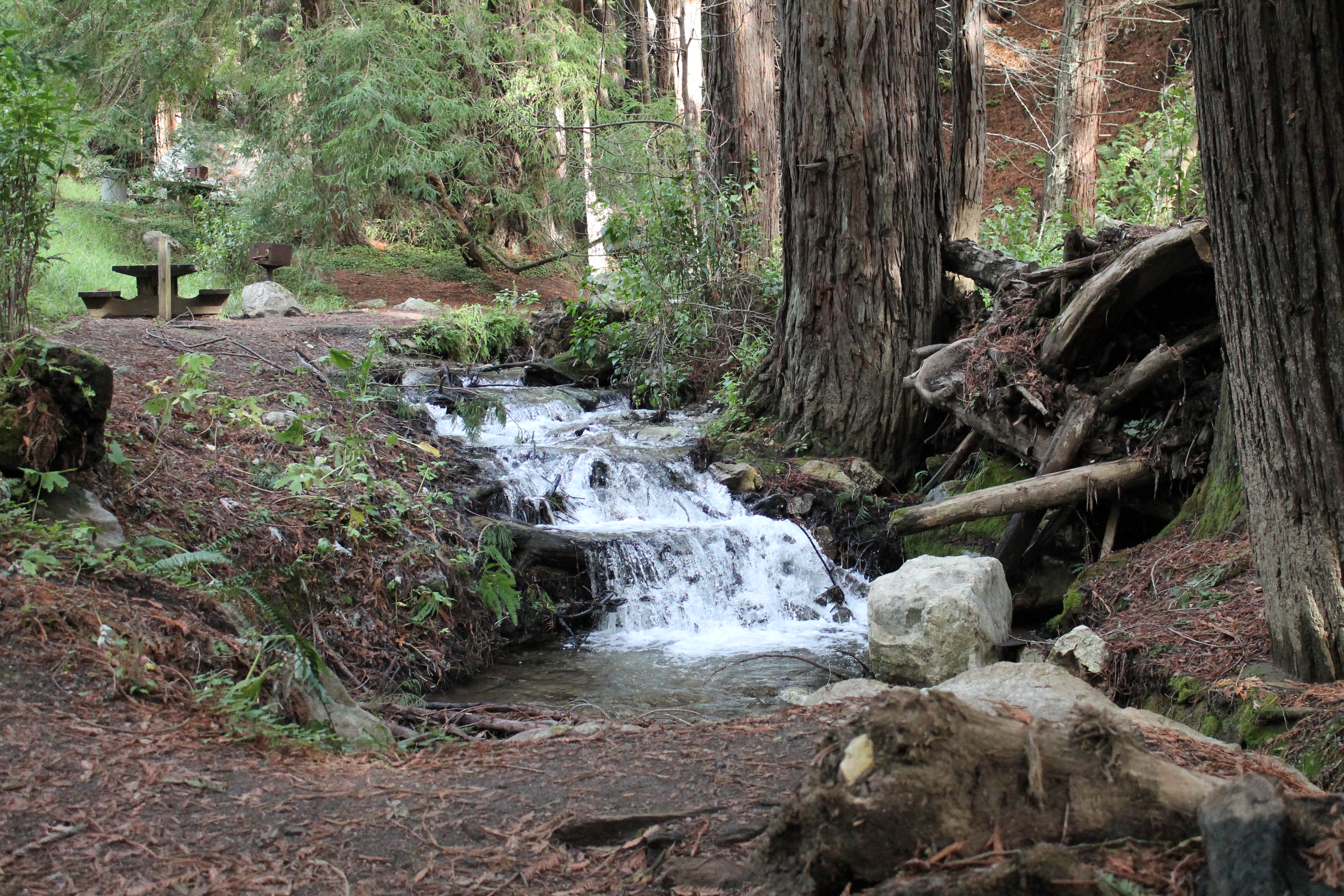
“We regularly talk of howling winds, and of chattering brooks. Yet these are more than mere metaphors. Our own languages are continually nourished by these other voices—by the roar of waterfalls and the thrumming of crickets, It is not by chance that, when hiking in the mountains, the English terms spontaneously used to describe the surging waters of the nearby river are words like “rush,” “splash,” “ gush,” “wash.” For the sound that unites all these words is that which the water itself chants as it flows between the banks. If language is not a purely mental phenomenon but a sensuous, bodily activity born of carnal reciprocity and participation, then our discourse has surely been influenced by many gestures, sounds, and rhythms besides those of our single species. Indeed, if human language arises from the perceptual interplay between the body and the world, then this language ‘belongs’ to the animate landscape as much as it ‘belongs’ to us.”
 The more I write, the more I see how language not only shapes the worlds we inhabit, but how that “perpetual interplay between body and the world,” between I and Other, shapes us, our language, and how we know each other.
This all may sound rather mystical, but theoretical science makes similar claims. Noted physicist Werner Heisenberg once wrote: “What we observe is not nature in itself, but nature exposed to our method of questioning.” His colleague Niels Bohr echoed that observation: “It is wrong to think the task of physics is to find out how nature is. Physics concerns only what we can say about nature.”
 The importance of language in shaping not only what we know about the world but what we can know about the world is the subject of Bruce Gregory’s Inventing Reality, Physics as Language. At the end of his book in which he writes about the work of Heisenberg, Bohr, Einstein, and other modern physicists, he concludes:
“Physics shows that while the world shapes us, the language we use shapes the world. We might even say the language we are shapes the world, for language undoubtedly defines us more profoundly than we can begins to imagine.”
Related articles
- Scientist’s Quotes (aumparasamgate.wordpress.com)
- Eye and Mind (bodyoftheory.com)
Discover more from Deborah J. Brasket, Author
Subscribe to get the latest posts sent to your email.

Fascinating thoughts and words… and so true… I notice I don’t refer to someone’s illness, but to their situation, so that I don’t imprison them in the concept of illness,
Words reflect so much of ourselves, and define our lives , so choosing those words is crucial it seems to me…even to trivial things like ‘killing time”, ‘spending time’, ‘using time’,’ making the most of time!’
LikeLike
I like your examples of how we need to be more careful about the words we use. Some common expressions like “killing time” we use so thoughtlessly, but they really do shape how we are experiencing time in that moment, and how a different way of looking at it could change the way we experience it. Really appreciate what you’ve added here!
LikeLike
Language does define our human nature; I wonder what the languages really are of the rest of the world.
LikeLike
Interesting question. Mathematics is the language of physicists, so they say. Music and the visual arts are types of language, I believe. Then there’s the language of bees, and dolphins and other creatures. Hmmm . . . what else? Body language?
LikeLike
We cannot master all languages; maybe we should master courtesy, and listen when others, of any kind, speak.
LikeLike
This is great, Deborah. I am a David Abram fan myself, so seeing you quote him certainly made me smile.
I think that one of the most rewarding things about writing and conversing is feeling myself nourished by our world. I am always trying to find ways of letting the natural world speak through me and making myself -as well as I can- a conduit for the voices I hear outdoors and the images I see.
I really enjoyed this post.
LikeLike
Thank you, Jeremy. I’m not surprised that you are an Abram fan. Your writing really reflects that connection with the sensual/natural world.
LikeLike
I have become an ardent student of philosophy and I love Abram’s de-emphasis on the mind and his emphasis on the whole body as the thinking-perceiving membrane. This is a take on the idea of reason that has special appeal to me because of my connection with the sensual/nature but also my long-standing discomfort with the reduction of the non-human to an “it” in much western thought (Francis Bacon’s interrogation of nature).
Robert Bly edited a book of poems back in the 1980s that deals with this subject: News of the Universe. Sierra Club Books published it. Have you heard of it?
I read it and his essays about the development of poetry in conjunction with philosophy and it opened up my eyes to a much wider world.
LikeLike
Yes, Abram’s emphasis on the more-than-human world has inspired a lot of my writing/thinking, and has helpedexplain why I feel such a connection, a being at home, in “nature.” Bly’s book sounds like something I’d enjoy. I’ll have to get hold of it
LikeLike
If you’d like to have a glimpse, here is a link to Bly’s book:
http://books.google.ca/books/about/News_of_the_Universe.html?id=4OOk3ryCuu4C&redir_esc=y
LikeLike
Deborah – Thank you for the inspiring words, and, of course, for mentioning my blog post on ‘Eye and Mind’. I especially enjoyed your introduction on personification, and it reminded me of the discussion of bodily references in Lakoff and Johnson’s ‘Metaphors We Live By’, which I’m sure you know very well. Interestingly, a similar point is made by Vico in the ‘New Science’ in 1725, in the section on ‘poetic wisdom’. I also wondered if you’d made the connection with the recent neuroscience research on ‘mirror-neurons’, which seems to give a new basis for the kind of empathic connection between self and other that you refer to?
Thank you again – and best wishes, Jonathan
LikeLike
I’m familar with Lakoff’s work, but haven’t read “Metaphors we Live By”–sounds like something I should take a look at. I want to find out more about the mirror-neurons you mention too. This is one of the things I love about blogging–making these connections with others interested in similar topics and expanding what I know about the world. I’m so glad you enjoyed this post–I found your site fascinating too.
LikeLike
Thanks for your reply. Actually Mark Johnson’s more recent book ‘The Meaning of the Body’ (ch.7) is probably a better source than ‘Metaphors We Live By’, where they were slightly more disparaging about the ‘partial’ nature of metaphors of bodily form (p.52-55). Examples like the ‘brow of the hill’ or the ‘lip of the cup’ are also discussed in a more positive way by Vico (para 405/p.129). On mirror-neurons I’d recommend Marco Iacoboni’s book ‘Mirroring People’, which is very accessible.
LikeLike
I will take a look at both of those books. Thanks so much for letting me know about them.
LikeLike
What an insightful and extremely well-written post. I especially stopped to consider the point about words that we use to describe water really sounding like the movement of water itself. I never considered that personification is as much about the observer as the observed.
LikeLike
Thank you, Lila! I really appreciate your comment and so glad you enjoyed the post.
LikeLike
I have no idea why that posted under “Lila.” It’s actually Kiersi. Sorry!
LikeLike
Weird how things like that can happen on the internet! Not to worry, Kiersi, but glad to know who you really are!
LikeLike
Thanks for the Bly link, Jeremy!
LikeLike
Deborah – now that I am just returned and seeing what my favourite bloggers have been up to, I am being drawn once more into so many interesting worlds. I thought this post was a great look at the world outside, and also within, and I love the way you made your connections. It’s good to be back and able to enjoy such gems. (Please give me a day or two to respond to emails.)
LikeLike
Thank you, dear Gabriela. Glad you returned safely from your trip.
LikeLike
this relatively new blogger, writer and poet sincerely thanks you for liking some of my work on the 20 Lines A Day Poetry page, the encouragement means a lot to me and so does this sentence.
‘We might even say the language ‘we are’ shapes the world, for language undoubtedly defines us more profoundly than we can begins to imagine.’
the more i write, the more i am my words.
:::merci:::: and keep the light.
LikeLike
You are so welcome. It’s lovely when we discover like-minded writer/bloggers whose work we can enjoy and support.
LikeLike
Hey! I am not sure if you accept blogging awards, but I have nominated you for the Very Inspiring Blogger award. Do check out this link for more details:
LikeLike
I’m honored! Thank you so much Sumithra!
LikeLike
Wonderful blog. Just this morning I was listening to a National Public Radio segment about how we so naturally turn nature into our metaphor. You’re right with it!
LikeLike
Thank you! I so appreciate your stopping by and leaving a comment. I love those NPR programs–always something new and interesting.
LikeLike