Tags
art, bearing witness, Bernie Glassman, Does It Make Me Less Kind?, Homelessness, living on the street, Marc Clamage, Michelle Ayon Navajas, Paintings, panhandling, poetry
We’ve all seen the headlines, how the homeless are being harassed, their tents and belongings bulldozed away, being told to move on with no place to go, since there’s not enough shelters to bed even a small fraction of the people who can’t afford to rent rooms in a motel, let alone an apartment or a home. It’s as if we don’t want to see them. We want them to disappear out of our sight so we can pretend they don’t exist.
All this has become exasperated under Trump’s tyrannical edicts and fascination with martial law, sending in the National Guard to terrorize the very people they were sworn to protect by destroying their homes and belongings.
It’s enough to make those who care about Democracy, who care about the most vulnerable among us, want to curse and rage, as one poet laments:
Does It Make Me Less Kind?
would it make me less kind
if i spoke my mind—
if i stood and disagreed
with the filth parading as normal,
the unscrupulous things
we’re told to ignore?
would it make me less kind
if i cursed your leader
for clearing the homeless
from scraps of shelter
because they don’t fit
the city’s pretty picture?
would it make me less kind
if i hated the politicians
who run for office
not to serve,
but to feast—
on power,
on profit,
on the backs of those
they swore to protect?
i could go on,
rambling,
maybe cursing,
maybe hating.
but tell me—
does it make me less kind
to care
so much
it burns?
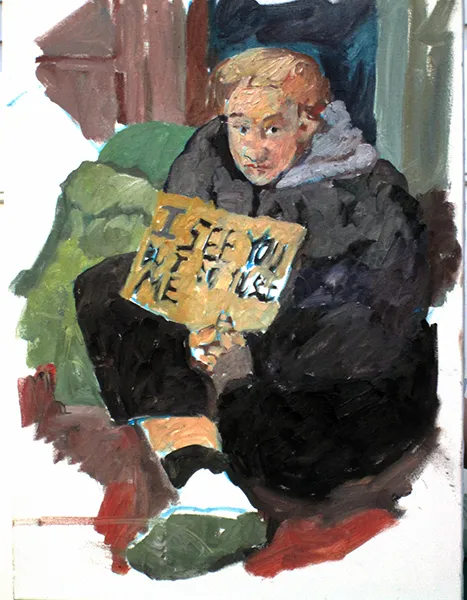
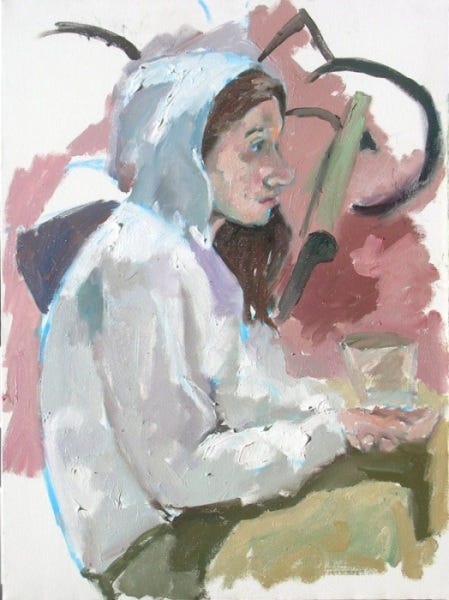
Those of us who care enough can’t turn away. Even if we are helpless to change what’s going on, we can throw a light on it, as artist Marc Clamage did, bearing witness one face at a time by painting panhandlers he saw in Boston Harvard Square near his workplace over the course of three years.

“I used to hurry by them,” writes artist Marc Clamage, “but then I began to stop. Each face tells a story, I realized, and I would try to capture as many as I could through a series of oil paintings.”
He’d noticed there were more than usual that year, and that they seemed “younger, and more troubled.” Sometimes even whole families begging on the streets.

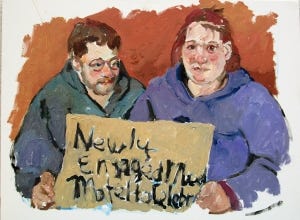
Many of the people he encountered were simply passing through, on their way to a new job or to visit family. Some panhandled to supplement a low-wage job, or help pay the rent.
Others were homeless. Panhandling was their only source of income. A few of these were mentally disturbed, or drug addicts. Some were sick and dying.

Marc writes: “I do not ask the panhandlers to ‘pose’ for me, but to carry on with their business. I pay each person $10, though I wish I could afford more, because they earn that small fee in the hour or two it takes me to paint them.
“Over that time, we often get to talking, which has been a privilege and an education.

“I’ve seen or heard many human dramas: the tragic love story of Gary (the Desert Storm vet) and Whitney (the cancer victim); squabbles over the best places to work; the mysterious figure everyone calls “The Rabbi,” stuffing $20 bills into cups and disappearing before anyone can see his face.

“I’ve witnessed a few instances of cruelty, but many more of thoughtfulness and generosity. And when I head home, I’m always struck by one thought: There but for the grace of God go the rest of us. Perhaps that’s why we find panhandlers so hard to look at.”
I was deeply touched by Marc’s paintings and by the stories of the people who posed for him. You can view more of his paintings and read the stories on his website “I Paint What I See”.

I also like what he says about how he paints:
“I paint what I see, only what I see, only with it right in front of me, only while I’m looking right at it. I do not work from photographs, or imagination, or memory, or even from sketches. I paint exclusively from life. The essence of representation is that every choice, every brushstroke must be made in direct response to the experience of visual reality.”
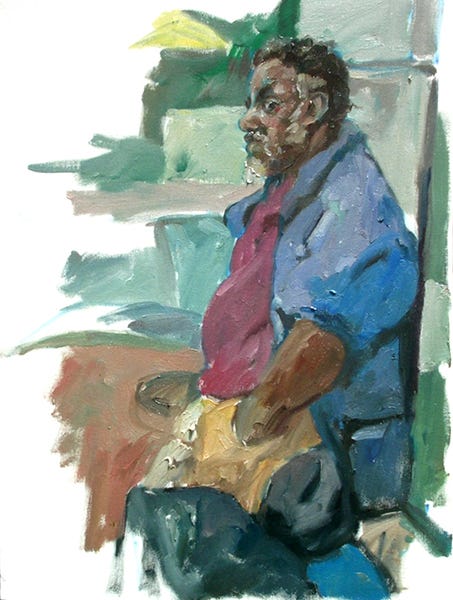
To really “see” someone, the way an artist does, objectively, without judgement, and yet responding to what is seen, the pain, or loneliness, or confusion, or anger; to see and be seen like that, must be freeing, for both the painter, the one painted. And for the viewer as well.
To simply behold what we see—the good and bad and beautiful and ugly—without judgement, but with compassion and humility, is the essence of “bearing witness.” And it must have a healing effect.

Bernie Glassman in “Bearing Witness: A Zen Master’s Lessons in Making Peace” wrote:
“In my view, we can’t heal ourselves or other people unless we bear witness. In the Zen Peacemaker Order we stress bearing witness to the wholeness of life, to every aspect of the situation that arises. So bearing witness to someone’s kidnapping, assaulting, and killing a child means being every element of the situation: being the young girl, with her fear, terror, hunger, and pain; being the girl’s mother, with her endless nights of grief and guilt; being the mother of the man who killed, torn between love for her son and the horror of his actions; being the families of both the killed and the killer, each with its respective pain, rage, horror, and shame . . . and being the jail cell holding the convicted man. It means being each and every element of this situation.”
To bear witness in that way must be the hardest, the most healing, and the most humbling thing we could ever do. And the most needed.
Elsewhere, Glassman writes: “When we bear witness, when we become the situation — homelessness, poverty, illness, violence, death — the right action arises by itself. We don’t have to worry about what to do. We don’t have to figure out solutions ahead of time. . . . Once we listen with our entire body and mind, loving action arises.”
See if you see what inspired him to paint these people. Sometimes we see something that cannot be “passed over” lightly, but must be “passed on” to others in whatever way we have of preserving them: in paint or print, or images on a blog site. So I pass these on to you.
This is an updated version of a 2014 post.
Addiction and homelessness are major themes in my novel When Things Go Missing. It explores what it means to be truly seen by another human being. It’s now available for pre-order at Amazon, Bookshop, and Barnes & Noble. Help my novel be seen. Your purchase would mean the world to me. Many thanks.
Discover more from Deborah J. Brasket, Author
Subscribe to get the latest posts sent to your email.

I worked in downtown Sacramento for more than 25 years, an area with a lot of homeless people. One of the things I’ve done over the years is occasionally give one of those people a story. One morning I got to work and one side of the building was taped off as a crime scene. A body had been found there. I went home that night and wrote a fictional obituary about the man because I figured nobody else did.
And another project I started years ago and finally finished last year. It’s what I call a connected series of short stories that tell a larger story. It features a number of the people I saw downtown. Some of them homeless, some of them not. I gave them all a story of their own and connected it to an event that ended the collection.
I feel like it’s the least I can do — to give them stories. To make them human. Because so many people walk on by without a thought or anything else.
LikeLiked by 2 people
That’s really impressive, Marc. What a wonderful thing to do. Have you collected your short stories into a book?
In a way, it’s kinda what I was doing in my novel, giving stories to some of the street people I’ve seen or heard about. It was only recently that I realized some of the street characters I write about were based on two of these paintings. It wasn’t intentional. But after revisiting this post recently I realized that the character in my book named Gideon is based on this painting of Gideon and his story. And the character I call Wanda looks and sounds a lot like Laurel. Funny how the consciousness stores these things and brings them forth in our writing.
LikeLiked by 2 people
The connected set of short stories is about 15,000 words. Too short to be a stand-alone unless I just went the ebook route. I want to come up with some additional stories set in Sacramento and put them together in a Sacramento collection.
LikeLiked by 1 person
It is very sad to see the growing number of unhoused people and how cruelly they can be treated. I loved the poignant verse and compassionate approach to seeing them with Marc’s paintings.
LikeLiked by 2 people
I know what you mean, Brad. I was really struck by the poem which I read recently, and that made me revisit this old post and put the two together with an update on our current situation. It seems like instead of getting better, it’s getting worse.
LikeLiked by 1 person
You know this is a subject/experience near and dear to my heart…thank you for keeping the light on this in such a (he)artful manner. I wish for you continued peace in your personal connections to this.
LikeLiked by 2 people
Thanks, Laura. Hugs
LikeLiked by 1 person
A beautifully put together post, thoroughly enjoyed it… Thank you for sharing.
LikeLiked by 1 person
Thank you, Samantha! I appreciate that.
LikeLike
A powerful post, Deborah, and Mich’s poem is spot on. These verses resonate deeply:
would it make me less kind
if i cursed your leader
for clearing the homeless
from scraps of shelter
because they don’t fit
the city’s pretty picture?
would it make me less kind
if i hated the politicians
who run for office
not to serve,
but to feast—
on power,
on profit,
on the backs of those
they swore to protect?
Thank you for spreading awareness. ❤️
LikeLiked by 2 people
Thank you, Lauren! I felt the same way when I read Mich’s poem–I had to share it. And I was moved to re-share these paintings as well.
LikeLiked by 1 person
❤️❤️
LikeLike
Amen. I would not be in the least surprised if within a year or two of fake prez administration #2 the plan is leaked to have 2AM raids round up homeless people and drop-ship them to Namibia. You know, cause Trump got offended by seeing them on the way to McDonalds in a limo somewhere.
LikeLiked by 2 people
Sadly, I’m afraid of that too. People being rounded up and sent off where they can be forgotten, instead of doing what needs to be done, creating housing for the unhoused and addressing the root causes of homelessness.
LikeLike
A touching and heartbreaking post, Deborah. The depravity of the Trump administration and their bullying assault on all sorts of vulnerable people in this country is outrageous. Michelle’s poem, her dismay, and her question were all relatable to me . Marc’s paintings give his subjects faces and names and human stories. I like his commitment to bearing witness, as well as Glassman’s quote on what that means and how it leads to right action. Fabulous post.
LikeLiked by 2 people
Thank you, Diana. I’m so glad we are all on the same page politically here. Michelle’s poem and Marc’s paintings touched me so much I knew I had to put them together to shine a light on this problem. At least I can do that much.
LikeLiked by 1 person
We do have the power of our voices, and that’s meaningful. ❤
LikeLike
God bless all the soul’s . May God Give them strength to face difficulties and overcome them with God’s love and mercy ❤️❤️ Surrender to God from your heart & Soul That’s changed My life .
LikeLike