Tags
art, creativity, Georgia O'Keeffe, inspiration, Mary Oliver, poetry, the creative process, writing
What precipitates the creative process?
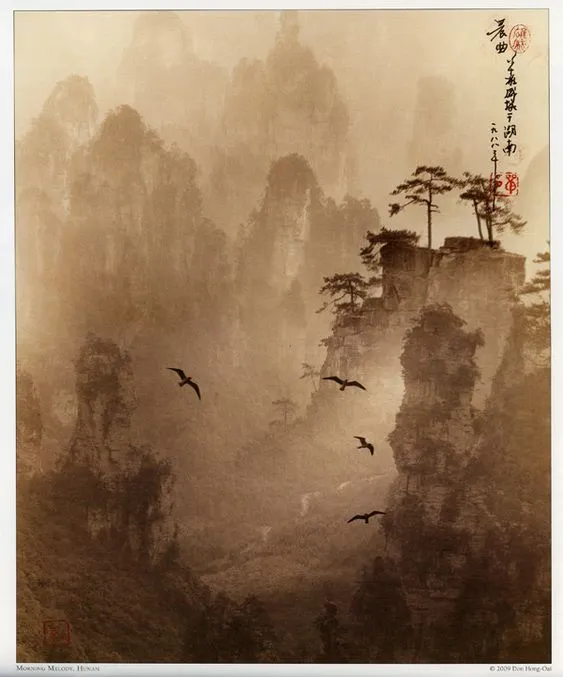
For poet Mary Oliver, it’s the need to step over “the edge” into something vague and nearly inarticulate, to make “a form out of the formless”:
No one yet has made a list of places where the extraordinary may happen and where it may not. Still, there are indications. Among crowds, in drawing rooms, among easements and comforts and pleasures, it is seldom seen. It likes the out-of-doors. It likes the concentrating mind. It likes solitude.
It is more likely to stick to the risk-taker than the ticket-taker. It isn’t that it would disparage comforts, or the set routines of the world, but that its concern is directed to another place. Its concern is the edge, and the making of a form out of the formlessness that is beyond the edge.
—-From “Of Power and Time,” Upstream: Selected Essays (public library).
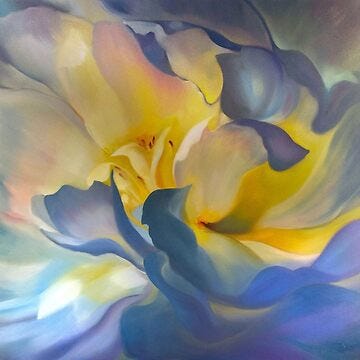
For artist Georgia O’Keeffe, it’s the urge to make the unknown known:
I feel that a real living form is the result of the individual’s effort to create the living thing out of the adventure of his spirit into the unknown—where it has experienced something—felt something—it has not understood—and from that experience comes the desire to make the unknown—known.
By unknown—I mean the thing that means so much to the person that wants to put it down—clarify something he feels but does not clearly understand—sometimes he partially knows why—sometimes he doesn’t—sometimes it is all working in the dark—but a working that must be done—
Making the unknown—known—in terms of one’s medium is all-absorbing—if you stop to think of the form—as form you are lost—The artist’s form must be inevitable—You mustn’t even think you won’t succeed—Whether you succeed or not is irrelevant—there is no such thing.
Making your unknown known is the important thing—and keeping the unknown always beyond you—catching crystallizing your simpler clearer version of life—only to see it turn stale compared to what you vaguely feel ahead—that you must always keep working to grasp—the form must take care of its self if you can keep your vision clear.
For both Oliver and O’Keeffe, the creative process is about the urge to push consciousness over the edge, beyond the ordinary perception or understanding of things as they seem to be, to discover what else lies out there just beyond our grasp.
Whether it’s a painting or poem or story, it comes like a tickle in the back of the mind–-an inkling of something exciting, extraordinary, brand new and undiscovered, just out of reach. The conscious mind cannot make the leap into the great unknown. It’s too slow and cumbersome, too full of itself and its preconceptions. Too fearful of what’s not itself. But we sense that something else can. Some deeper part of ourselves that we rarely tap into can make that leap, if we are willing to risk letting go and allow it.
It’s like flying from one trapeze to another. We have to be willing to let go of what we so desperately cling to, to leap out into empty air with nothing to support us, and trust the thing we are reaching for will be there. Without that risk-taking and that trust, nothing extraordinary happens.
The thing that tickles our mind, that intrigues and arouses us, that we want to grasp, seems vague at first, formless. Like a tree hidden in the mist, we catch odd glimpses of a form we cannot recognize at first.
But as we pursue our art, our painting or our poem, it becomes clearer, almost as if we are reclaiming it from the mist that has obscured it. As if it already existed perfectly formed, and we are simply the tool used to reveal it, or, at least, reveal some small aspect of what we originally glimpsed.
What we bring forth may not be perfect, may not be the thing-in-itself, but merely hint at it. And that’s enough. To have touched, to whatever degree, that which intrigues us; to have given some slight form to that vague reality which tickled the mind, which once had lain unperceived among the formless, is enough to sate us, to satisfy the creative urge. At least for a while.
For having once tapped into that deeper part of ourselves, having once stepped over the edge and touched the form within the formless, we spark anew, again and again, the urge to create. To risk letting go and trust the empty air before us will bring to our fingertips the very thing we hoped to grasp.
What’s your creative process?
Is it anything like Oliver’s and O’Keefe’s? I’d really like to know. Please share in the comments below. And don’t forget to press “like” if you enjoyed reading this. Many thanks, always.
Tapping into a deeper part of myself was certainly needed to produce When Things Go Missing. Both risk and trust were at play when I decided to go Indie. You can read reviews from early readers and an excerpt at the link above. It’s now available for pre-order at Amazon, Bookshop, and Barnes & Noble.
Discover more from Deborah J. Brasket, Author
Subscribe to get the latest posts sent to your email.

Earlier in my poetry writing, I would say my creative process was similar, listening and dipping inward to claim the idea or words that wanted to come out. Now my writing is more mechanical, writing about my daily life.
LikeLiked by 2 people
I know what you mean, Brad. There’s the writing that’s poetic, artful, and then the writing that ‘s conversational, informational. Same with me. But what about your photography? I know in my paintings of flowers I’m trying to capture something that’s just past grasping in the beauty or sensuality or soulfulness I see there. I see in your photography as well, which is what I love about it. Then the way you crop it or zoom in adds to the mystery and alure. Is this creative process more like your poetry, or more mechanical, or a bit of both?
LikeLiked by 1 person
I’m glad you still see the spark in my photography. It has felt stale and rote.
LikeLiked by 1 person
It doesn’t look that way at all! But all creatives get burnt out sometimes. Taking a break might help. Do what bring you joy.
LikeLiked by 1 person
Thanks Deborah.
LikeLike
I think creativity makes people passionate. Well written. 👍🏼👍🏼
LikeLike
Thank you! I agree. It certainly makes me passionate.
LikeLiked by 1 person
Welcome hi visit my YouTube channel 🙂
LikeLike
Thank you for all of this, Deborah, especially these words from Mary Oliver about the urge to create:
“Its concern is the edge, and the making of a form out of the formlessness that is beyond the edge.”
There is something entirely existential about the tug to create, make things. Extensions of self, bravely bringing the interior into view…pushing to get things outside of myself. Feeling for the edge. Oh my goodness. Yes. xo! 💕
LikeLiked by 1 person
I’m glad you enjoyed this, Vicki! Yes, there is something existential. as you say, about this tug to create. Thanks for sharing your thoughts here.
LikeLiked by 1 person
💕💕💕
LikeLike
Yes. To all of this. Gorgeously written and expressed. Gorgeously illustrated. Perhaps your next book could be non-fiction touching this subject? You’ve written many articles along those lines…Ooops, just sayin’…
LikeLiked by 1 person
Thank you, Laura! That means a lot to me. That’s actually a lovely idea, gathering some of my essays here about art and creativity into a book. I will think about that.
LikeLiked by 1 person
These two paintings are both astounding. 🙂
What is my process? About half the time it goes something like this: I notice something, it could be something sensory, or an idea or cluster of ideas or maybe two concepts which seem to be usually not related. But whatever I noticed compels a slightly lengthier considering in me for some reason… and then I want to explore that reason. So I find the relations, the deeper interlocking. I go hunting with my openness, carried by the intuition that something is on the verge of becoming apparent. I write myself into seeing more.
LikeLiked by 1 person
Aren’t they? I do love them both. One of my favorite things about blogging is finding artwork that complements the subject matter.
I love what you say about your creative process: hunting with openness, write myself into seeing more. Absolutely! Thanks so much for sharing this.
LikeLike
“The conscious mind cannot make the leap into the great unknown.”
There’s an example of that in an account given by the great French mathematician Henri Poincaré:
“I wanted to represent these functions by the quotient of two series; this idea was perfectly conscious and deliberate; the analogy with elliptic functions guided me. I asked myself what properties these series must have if they existed, and succeeded without difficulty in forming the series I have called Theta Fuchsian.
“Just at this time, I left Caen, where I was living, to go on a geologic excursion under the auspices of the School of Mines. The incidents of the travel made me forget my mathematical work. Having reached Coutances, we entered a bus to go some place or other. At the moment when I put my foot on the step, the idea came to me, without anything in my former thoughts seeming to have paved the way for it, that the transformations I had used to define the Fuchsian functions were identical with those of non-Euclidian geometry. I did not verify the idea; I should not have had time, as, upon taking my seat in the bus, I went on with a conversation already commenced, but I felt a perfect certainty. On my return to Caen, for conscience’ sake, I verified the result at my leisure.”
LikeLike
My creative process is rooted in understanding how a piece of information helps my reader. I like my writing to carry an impact that would, in its own way, change a life a little bit.
LikeLike
Thank you for sharing your creative process, Gauri. I feel the same way, wanting to make an impact that helps people.
LikeLike