Tags
Addiction, art, art-making, beauty and brokeness, Deborah J. Brasket, debut novel, fantasy, fiction, Homelessness, Indies Today, Kintsugi, Love, mending broken things, metal sculpture, photography, street people, Suffer Strong, When Things Go Missing, writing

I’ve always been fascinated by the Japanese art of kintsugi and all it represents.
“The story of kintsugi—this style of pottery—may be the most perfect embodiment of all our trauma-shattered lives . . . . Instead of throwing away the broken beloved pottery, we’ll fix it in a way that doesn’t pretend it hasn’t been broken but honors the breaking—and more so, the surviving—by highlighting those repaired seams with gold lacquer. Now the object is functional once again and dignified, not discarded. It’s stronger and even more valuable because of its reinforced, golden scars.” From Suffer Strong, by Katherine and Jay Wolf.
I had the opportunity to practice this art when a ceramic bowl my brother made for me arrived broken. I glued together the pieces and painted the cracks with gold metallic acrylic.
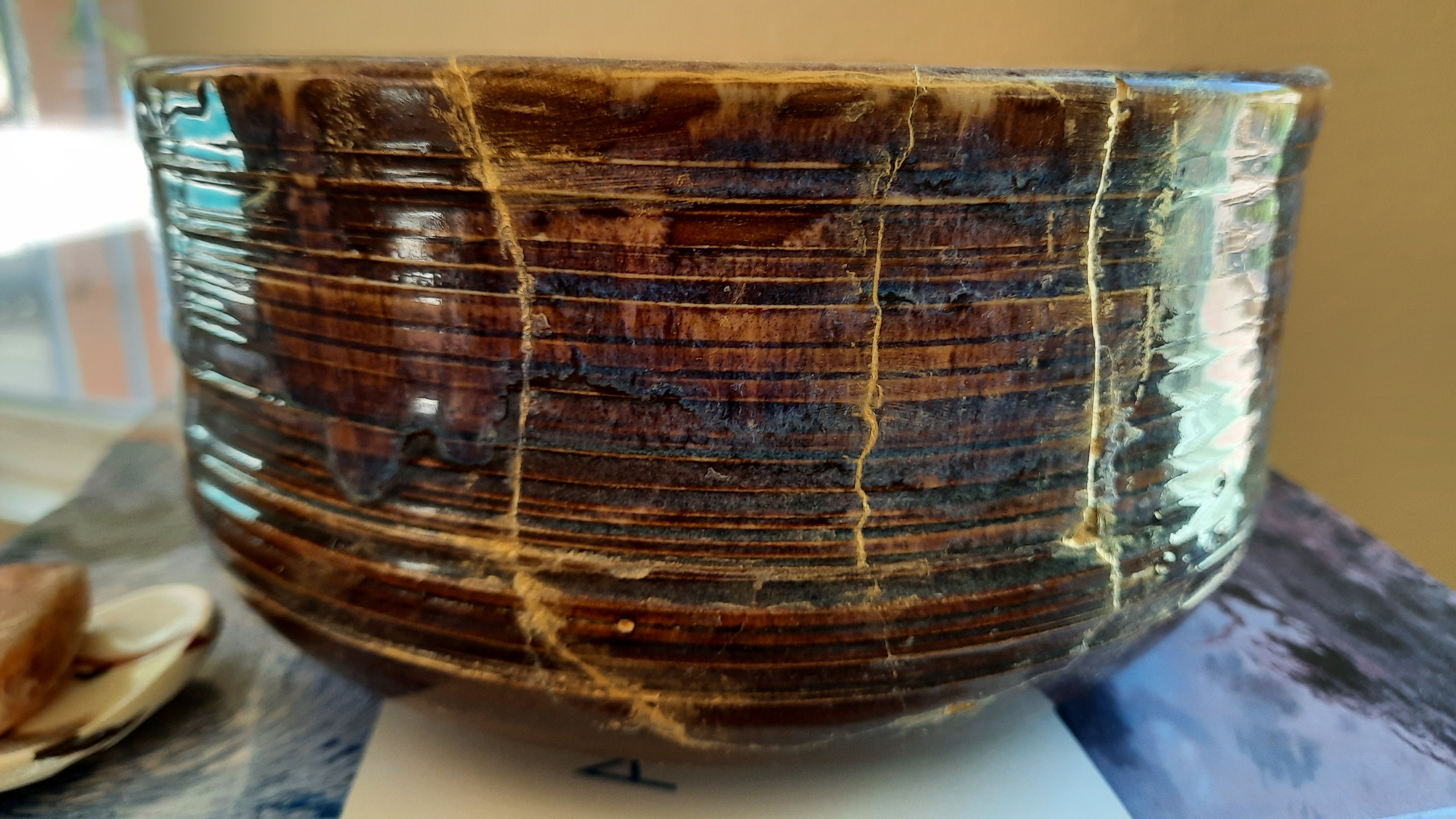
While beautiful before, it seemed more so after. Perhaps because of the love I poured into the bowl, saving something precious that had been broken. Or perhaps it was the way the vertical gold lines brought out the subtle colors in the horizonal design. Either way, it’s something I take pleasure showing off in my home.
So, already enchanted by the practice of Kintsugi, imagine my delight when I received this 5-star editorial review from Indies Today:
“If this novel were compared to an art form, it would be Kintsugi, the Japanese practice of repairing broken pottery with gold, embracing imperfections as part of the piece’s beauty. This philosophy of resilience mirrors the painstaking healing of Franny’s flawed yet deeply relatable family in When Things Go Missing. Deborah J. Brasket’s eloquent, intimate prose draws readers into an introspective journey where a fluid narrative voice moves effortlessly between a son hardened by addiction, a father weighed down by regret, and a daughter fueled by anger. By withholding Franny’s direct perspective and allowing others’ memories to shape her, the story shifts attention from a single devastating choice to the deliberate choices of those she left behind. Through compelling insights on addiction, homelessness, and creative ventures of the soul, readers become fully invested in the well-being of these realistically crafted characters, rooting for each to find the happiness, success, and fulfillment that have long eluded them. Part mystery, part engrossing family drama, When Things Go Missing is a poignant reflection not just on what leaves a mark, but on what binds us back together.” —by Nicky Flowers, Indies Today
I’d never associated the novel I wrote with the practice of kintsugi. But after reading this review, I realized it was. In so many ways When Things Go Missing is all about mending the broken pieces of one’s self or family. But it’s also about seeing the beauty in broken things, broken people, finding value in what so often is overlooked or thrown away.
We see this most readily in Cal’s chapters, a young man whose life has been broken by addiction. Early on in the novel he recalls how “he used to go treasure hunting with mom back in the day, before the bad times rolled in, searching through thrift stores and flea markets for under-appreciated treasure they could bring home. He really got into that, picking through the clutter and the piles of junk. Hours rolled by like minutes. He was good at it too—had a great eye his mom told him, the ability to see beneath the rust and tarnish what was bright and valuable.”
Later he talks about the street people he’s come to know: “the losers and users and dealers, that food chain of commerce and convenience he’s part of and depends on, which makes life on the street possible. Or at least tolerable.”
First there’s Mikey, who’s “not too bright, skinny as a screwdriver and about as sharp” who lives on his Aunty’s couch and gives Cal rides in exchange for his weed.
“Then there’s Wanda. She’s one wicked bitch—queen of Abel’s Mall. She rules the streets, the hardcore homeless, the homeless by choice . . . She’s hard as nails, but she gets a kick out of Cal, likes having him hang around, hearing his sweet talk, and giving him a hard time. He helps her out too—runs errands, boosts stuff, chases the bad guys away.”
Wanda took over when Gideon, “a big black sonofabitch with a bad eye, who’s not right in the head: Vietnam vet, three fingers missing on his left hand” was sent to Wasco prison.
But later when Cal turns to welding metal sculptures as part of his recovery, he turns these broken people, and his own broken self, into art.
“One day when he’s heating a flat, thin square of metal, it begins to melt. The whole surface blurs and blisters in long, fluid welts. He stops and steps back to examine the damage. It reminds him of a windowpane streaming rain or a steamy mirror that’s starting to run. For a second, he glimpses his own face reflected there looking back at him, blurry behind the wet surface—his face running with rain, dripping with steam. Immediately, he works the metal until he sees it, this bewildered face half hidden below the surface, looking out.
“After that, he starts a series of self-portraits. Not him writ large in myth or symbol but him writ small, twisted and turned inside-out—the way he saw himself, the way others saw him not so long ago. Him, fucked up and falling apart; him, piecing himself back together again. He uses squares of metal with screws for eyes, fuses for mouths, and knobs for noses. Jagged pieces of metal overlap each other, so you get the full face and its profile at the same time. What he sees is something alien and terrifying, or studious and curious, looking back at itself . . . .
“Later when he’s rummaging through a junkyard, he comes across an old porcelain electrode, round and stubborn, like a nose, and Wanda’s face flashes before his mind. He gathers more materials—a mess of copper wiring for her hair, a set of screws for her teeth. He welds together her face, this impossibly strong and intimidating face with eyes like a god, like something that sees right through your soul.
“Gideon is next with his wandering eye, mottled complexion, and motley beard, a look like he’d sooner eat you than look at you. Then he does Mikey, so thin and comical and goofy, so trusting and gentle that it makes you want to laugh and cry at the same time.
“If you look at these faces one way, they’re nothing but junk—odd bits of scrap metal, useless garbage, obsolete car parts thrown together. But if you look at them another way, you see the fierceness, the vulnerability, the loneliness. You see something interesting and unique. You see faces torn apart and reassembled, as they must have been, time and time again, every newborn day.
“He hangs these, and more like them, on the office wall with his self-portraits. Now when he opens the door, it’s like he’s looking into a crowd of people staring back at him—strange and wild and broken, but so infused with emotion it’s like a wave breaking over you, a wave of faces tumbling over and through you. His heart feels good, standing there, looking at them. Like something true that needed saying got said.“
Art-making is an important part of this novel. It starts with the strange photographs the mother who went missing sends Cal.
“Sometimes when he’s high, he comes here to look at the photos. He’s sure there’s some meaning behind them, something she’s trying to tell him. He numbers them as they arrive and hangs them in order, as if they’re letters of a word he can’t understand, hieroglyphs from some ancient tomb. He paces, wandering from one photo to the other, muttering to himself. He thrusts his face within inches of the images, examining them for clues, thinking if he studies them long enough, hard enough, he’ll see some sort of pattern or meaning emerge, some message, some trace of his mother and why she sent them, why she left.
“Most are shot cockeyed, and some are blurry like she was careless or drunk when she took them. There’s a close-up of a horny-head lizard with a mean face, wicked eye, and flash of tongue. But it’s in the bottom corner of the photo, the rest all empty desert and empty sky, like she didn’t know how to frame it right. She must have been lying on the ground to capture that shot. Why would she do that?
“Then there’s a photo of a nasty-looking rooster perched on top of a fence post, its wings in a flurry, beak open, eyes wild and furious. Another photo is of a dead tree, all bare limbs like outstretched arms, like someone shaking their fists at the sky or trying to tear it to pieces . . . .
“The lizard is his favorite. He looks startled somehow, like she snuck up on him when he was in the middle of his push-ups, one foot forward as if ready to scamper off. His eye is looking right at you as if he recognizes you and not sure he likes what he sees. All of it, the startled head, cold eye, raised foot, the empty sand and sky, gives the feeling of some fleeting, random moment captured for all eternity . . .
“The rooster also looks startled, shot from below, wings a blur of motion as if caught off-balance. His eyes are fierce, glaring down at her. His claws dig deeply into the grain of the wood fence post. . . . Something about the rooster and lizard stays with him, flitting in and out of his mind as he goes about the business of keeping body and soul alive on the wing. Something about those eyes follows him everywhere. Sometimes he dreams about them. The photos are pieces of his mother she cut from her own body and sent to him to preserve, to piece back together.”
Later he shows the “crazy stuff” his mom sends him to his friend Ivey, asking her what she thinks they mean. “What I see is, what they say to me, is something so . . . human, you know?” she tells him. “They’re about what it means to be human. Something beautiful and terrifying at the same time. Proud and unflinching. Fragile and fleeting. They show something in us that wants saving. That’s worth capturing on film and savoring.”
“He looks at Ivey and then at his mom’s photos and doesn’t know what to think. But something about these images does speak to him, some wildness there, something defiant and undefeatable. Some craziness he identifies with, and feeds on, and for all its potency, longs to let go.”
That’s what the art of kintsugi is all about, the art of saving and savoring things that are broken but too beautiful to throw away. It’s about seeing beneath the rust and tarnish, the scars and cracks, the addiction and craziness, finding what’s bright and valuable and honoring that.
If my novel shows even just a tiny bit of that, then all I’ve put into it is worthwhile.
When Things Go Missing is now available for pre-order at Amazon, Bookshop, and Barnes & Noble.
Discover more from Deborah J. Brasket, Author
Subscribe to get the latest posts sent to your email.

Oh wonderful review! Thank you for this article! I am going to buy your book right now and add it to my “to be read” list. I’m excited to dig in and experience the golden threads within it.
LikeLiked by 1 person
Thank you so much, Ka! That means so much to me. I hope you enjoy it. Let me know what you think after reading it.
LikeLiked by 1 person
I see that it doesn’t arrive until September, and I am very glad to receive it as soon as it arrives! Happy to pre-order. 💗
LikeLiked by 1 person
Thank you! I know it’s a bit of a wait and appreciate your patience.
LikeLiked by 1 person
You’re Welcome! I’m feeling pretty confident that it will be worth the wait! 😌🌞⭐️
LikeLiked by 1 person
Wow…the parallels to Kintsugi! Congratulations for the brilliant review and observation, Deborah.
Nicky Flowers nailed it — your book is a fascinating deep dive and “introspective journey”. Stories and characters drawn so expertly. Brava – again and again! 💕💕💕
LikeLiked by 1 person
Vicki, your support for this book has meant the world to me. Thank you so much for all you’ve done! Sending hugs and hearts!
LikeLike
Received! 🥰❤️🥰
LikeLiked by 1 person
What a fantastic review and analogy Deborah. Kintsugi is a wonderful art and way to look at our lives. I love the two vases you shared too.
LikeLiked by 1 person
Thanks, Brad. I’m so proud of my brother’s pottery. This was one of his first. Now his work is unbelievable and selling like crazy. I’ll have to do a post just on his artwork one of these days.
LikeLiked by 1 person
That sounds great. I look forward to seeing them.
LikeLiked by 1 person
Gorgeous pottery ‘fix’. The review is stellar and well deserved.
LikeLiked by 1 person
Thank you, Laura. I’ll have to share some of the other pottery my brother makes. Totally gorgeous.
LikeLiked by 1 person
Congratulations on your awesome review:)
LikeLiked by 1 person
Thanks so much, Kimberly!
LikeLiked by 1 person
🙂
LikeLiked by 1 person
Excellent! Congratulations!
LikeLiked by 1 person
Thank you, Dawn!
LikeLike
Brava you!!!
LikeLiked by 1 person
Thanks so much, Tricia!
LikeLike