Tags
art, bearing witness, beggers, Bernie Glassman, Blog, Homeless, I Paint What I See, living on the street, Marc Clamage, painting, panhandlers

“I see you but do you see me?” Maxine by Marc Clamage
Since my last post, I discovered another artist who refuses to turn away. He bears witness one face at a time by painting panhandlers he sees in Boston Harvard Square near his workplace.
“I used to hurry by them,” writes artist Marc Clamage, “but then I began to stop. Each face tells a story, I realized, and I would try to capture as many as I could through a series of oil paintings.”
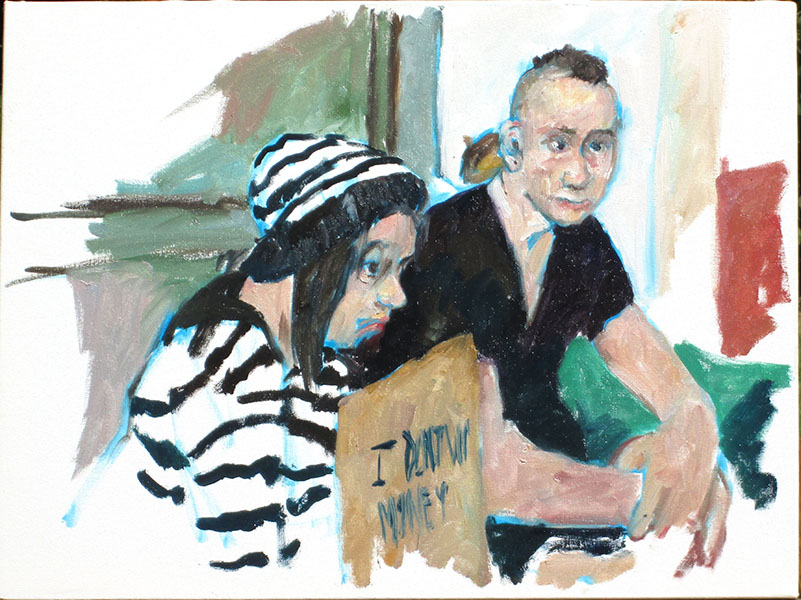
Rosie and David with pet guinea pig, by Marc Clamage
He’d noticed there were more than usual that year, and that they seemed “younger, and more troubled.” Sometimes even whole families begging on the streets.
Many of the people he encountered were simply passing through, on their way to a new job or to visit family. Some panhandled to supplement a low-wage job, or help pay the rent.
Others were homeless. Panhandling was their only source of income. A few of these were mentally disturbed, or drug addicts. Some were sick and dying.
Marc writes: “I do not ask the panhandlers to ‘pose’ for me, but to carry on with their business. I pay each person $10, though I wish I could afford more, because they earn that small fee in the hour or two it takes me to paint them.

“Newly Engaged, Need Motel to Celebrate” Justin and Lauren (The Lovebirds) by Marc Clamage
Over that time, we often get to talking, which has been a privilege and an education.
I’ve seen or heard many human dramas: the tragic love story of Gary and Whitney; squabbles over the best places to work; the mysterious figure everyone calls “The Rabbi,” stuffing $20 bills into cups and disappearing before anyone can see his face.
“I’ve witnessed a few instances of cruelty, but many more of thoughtfulness and generosity. And when I head home, I’m always struck by one thought: There but for the grace of God go the rest of us. Perhaps that’s why we find panhandlers so hard to look at.”
I was deeply touched by Marc’s paintings and by the stories of the people who posed for him. You can view more of his paintings and read the stories on his website “I Paint What I See“, or at his blog.

Gary, Desert Storm Vet, by Marc Clamage
I also like what he says about how he paints:
“I paint what I see, only what I see, only with it right in front of me, only while I’m looking right at it. I do not work from photographs, or imagination, or memory, or even from sketches. I paint exclusively from life. The essence of representation is that every choice, every brushstroke must be made in direct response to the experience of visual reality.”
To really “see” someone, the way an artist does, objectively, without judgement, and yet responding to what is seen, the pain, or loneliness, or confusion, or anger; to see and be seen like that, must be freeing, for both the painter, the one painted. And for the viewer as well.
To simply behold what we see–the good and bad and beautiful and ugly–without judgement, but with compassion and humility, is the essence of “bearing witness.” And it must have a healing effect.
Bernie Glassman in “Bearing Witness: A Zen Master’s Lessons in Making Peace” wrote:
“In my view, we can’t heal ourselves or other people unless we bear witness. In the Zen Peacemaker Order we stress bearing witness to the wholeness of life, to every aspect of the situation that arises. So bearing witness to someone’s kidnapping, assaulting, and killing a child means being every element of the situation: being the young girl, with her fear, terror, hunger, and pain; being the girl’s mother, with her endless nights of grief and guilt; being the mother of the man who killed, torn between love for her son and the horror of his actions; being the families of both the killed and the killer, each with its respective pain, rage, horror, and shame; being the dark, silent cell where the girl was imprisoned; being the police officers who finally, under enormous pressure, caught the man; and being the jail cell holding the convicted man. It means being each and every element of this situation.”
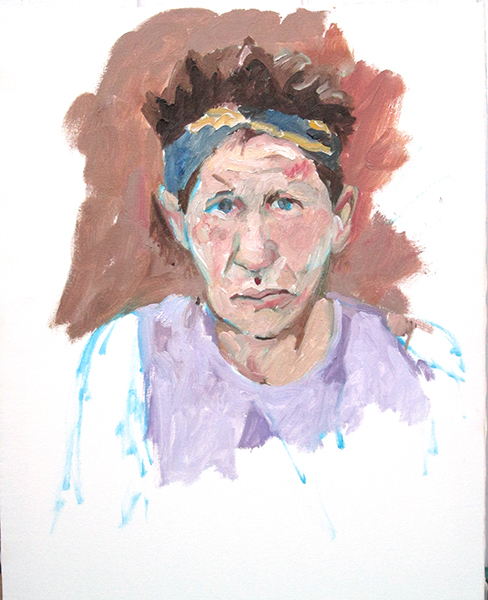
Whitney, cancer victim, by Marc Clamage
To bear witness in that way must be the hardest, the most healing, and the most humbling thing we could ever do. And the most needed.
Elsewhere, Glassman writes: “When we bear witness, when we become the situation — homelessness, poverty, illness, violence, death — the right action arises by itself. We don’t have to worry about what to do. We don’t have to figure out solutions ahead of time. . . . Once we listen with our entire body and mind, loving action arises.”
More of Marc’s paintings follow. See if you see what inspired him to paint these people. Sometimes we see something that cannot be “passed over” lightly, but must be “passed on” to others in whatever way we have of preserving them: in paint or print, or images on a blog site. So I pass these on to you.

Colleen, by Marc Clamage. Died of exposure and a drug overdose.

Gideon, by Marc Clamage

“Too ugly to prostitute, too kind to pimp.” Anthony by Marc Clamage

Maria by Marc Clamage

Laurel by Marc Clamage. Her sign says she’s a mother of 4 and victim of domestic violence. On the flip side it says “I’m not a whore, asshole.”

Carrie by Marc Clamage. Now clean and sober and off the streets.
[This post originally appeared on another blog in a slightly different form]
Discover more from Deborah J. Brasket, Author
Subscribe to get the latest posts sent to your email.

Wow! These are really interesting images, yet I realize they also put us in the awkward position of appreciating them more once they are captured as “art” than when we see similar people on the streets of our own neighborhoods. I like that you nudge your readers to “see” the people they would prefer not to see.
LikeLike
Thanks Kelly. You make a good point, about how we allow ourselves to really look at them as art, when in person, it would feel rude to stare at people we pass that way. Art gives us the time and opportunity to really “see” others.
LikeLike
“Part Two” of a subject that is near and dear to my (he)art and which is expressed well indeed via the artwork presented here.
I wanted to reblog your previous post (“Part One”), but discovered I cannot since I am WP.org…sigh…
Thank you for giving gracious attention to these ‘invisible ones.’
peace
LikeLike
Thank you Laura. Strange how WP.com and .org don’t have better ways to co-promote their bloggers.
LikeLike
What a marvelous couple of posts! Beautiful pictures of our own broken culture. These people are ourselves. There but for fortune…
As you probably know, I wrote a novel about homeless people, and how a Martha Stewart type loses everything and in the end becomes “invisible”. I add a level of humor to my story, but it’s another approach to the same story these paintings tell.
What a great blog!
LikeLike
Thank you, Anne. I hadn’t realized you’d written on homelessness. I will have to take a look at that. I agree, humor is a way to allow us to look at difficult situations, to cut through our preconceptions, and allow us to “see” it in a new way. It’s strange how humor can protect us and arm us at the same time. (I wrote a post about that too!) Thanks for coming and commenting.
LikeLike
Deborah–It’s No Place Like Home, set on the Central Coast. Partly in a homeless camp in Edna Valley. The homeless people are the heroes. http://amzn.to/1kRhb2k It would fit right in with this series of paintings.
LikeLike
It’s on my to-read list!
LikeLike
But. I saw you
LikeLike
Nice article
LikeLike
Thanks for sharing this. I love the work of this artist – what a noble project! I believe an important reason for doing portrait art is to validate the uniqueness and significance of a single human being – in other words make someone feel special and even loved. I suppose this is a little different from the idea of bearing witness but I also think acknowledgement of the person’s existence is part of these portraits. I agree that to “become” the suffering of others is a high calling and one of the most healing things we can do for ourselves and for others. When you at least attempt to do this it certainly does prevent you from setting yourself above others to the extent that you would deliberately benefit yourself at someone’s expense.
LikeLike
Yes, I love how you put it “to validate the uniqueness and significance” of each person we encounter, no matter their circumstances. But it’s especially important for people who are often maligned and misunderstood, ignored and forgotten. Thank you so much for coming here and sharing your thoughts.
LikeLike
I agree with a previous commenter … a noble project. Bringing dignity to these people painting them on the spot and paying them, thereby raising awareness.
Thank you for sharing
LikeLike
toll !
LikeLike